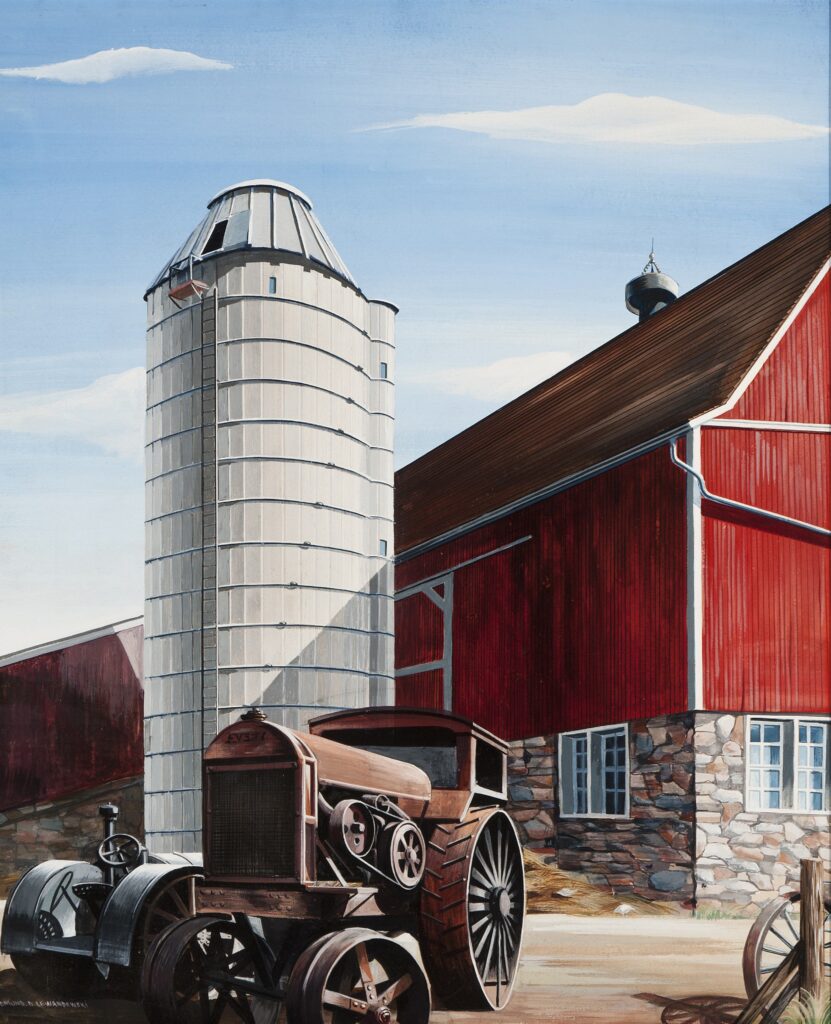
Red Barns (After the Harvest), c. 1942
Gilbert Stuart was born in 1755 in Saunderstown, Rhode Island to a wealthy family. Interestingly, he was born with the last name “Stewart,” but had it changed so that he would be associated with the English royal family. Stuart was greatest influenced by the Scottish-American portraitist, Cosmo Alexander. In his later years in Boston, Stuart influenced John Trumbull and Thomas Sully. Stuart was the foremost portraitist of his day and is deeply remembered for his portraits of George Washington, one of which is the basis for the engraving that appears on the one-dollar bill. Stuart painted directly on the canvas and was thus able to paint a remarkable amount of portraits.
In 1761, Stuart and his family moved to Newport, Rhode Island, where he received training from the portraitist Samuel King. As an adolescent, Stuart’s talent for drawing led to an apprenticeship with Cosmo Alexander, who also brought Stuart on a trip to Edinburgh, Scotland. Sadly, Alexander passed away during the excursion, leaving Stuart destitute. Stuart had to work his way back to the Colonies as a seaman. Stuart travelled to London in 1775, this time receiving training from the historical painter Benjamin West, who instilled stylistic similarities of Rembrandt’s and portraitist Sir Joshua Reynolds’ work into the young artist. Stuart’s career effectively began in 1882 when one of his portraits was displayed at the Royal Academy, despite previous exclusion of American artists. Stuart established studios in Ireland and New York, before settling in Germantown, Pennsylvania in 1795. Here, the legendary painter’s most famed portraits were created.