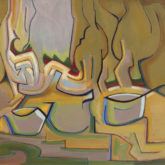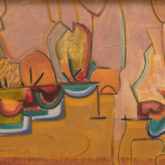
The Road to Quarry
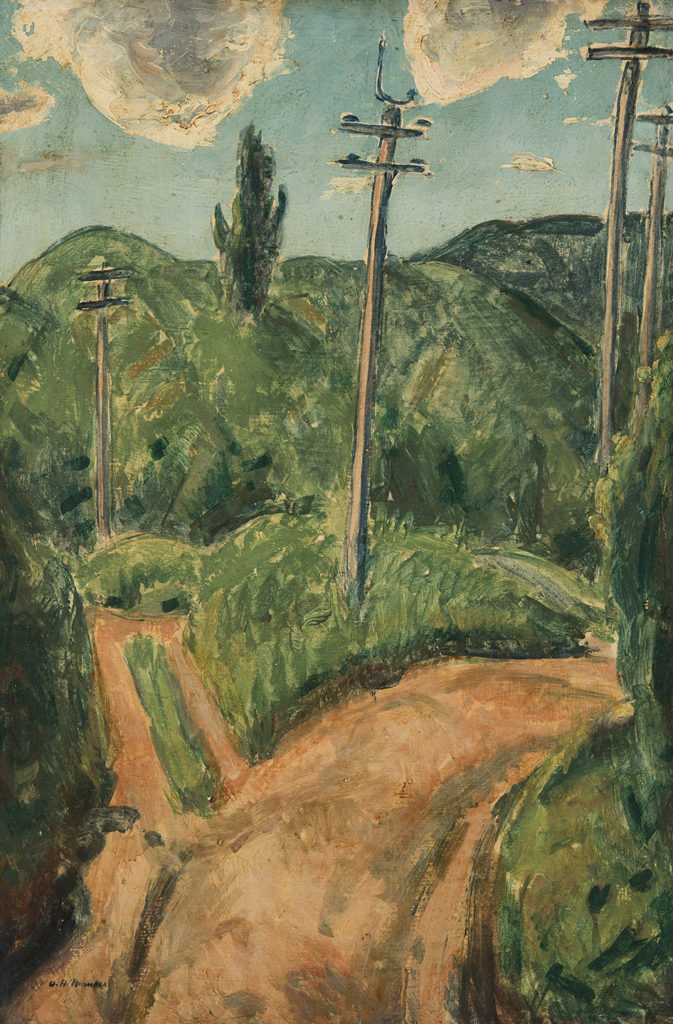
Alfred H. Maurer
The Road to Quarry, c. 1925
Oil on canvas
30 × 19 12 inches
Signed at lower left: A. H. Maurer
Provenance
The artist; to
Private collection, New York, by 1932;
Thence by descent in the family to the present owners
Description
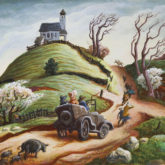
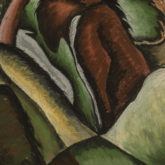
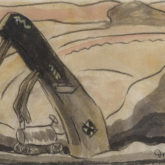
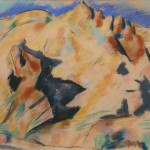
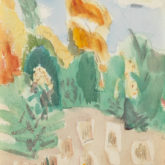
Alfred Maurer was among the vanguard American modernists, embracing a fauvist idiom as early as 1907, and progressing through post-Impressionism and Cubism through the end of his life in 1932. Maurer’s earliest landscapes in a modernist mode were experiments in Fauvism. Taking cues from the still-developing French movement, Maurer applied color radically with broken brushstrokes in his landscapes of 1906-13. While he never ceased his extreme experiments with color, by the 1930s he had moved to a cubist structure, uniting those ragged strokes into planes and boundary lines. In the 1920s, he often executed works in his signature fauvist manner, but the present work is an example of a different pictorial strategy. In Road to Quarry, the color is largely naturalistic. The landscape itself is given a rounded, volumetric treatment, not dissimilar to the contemporaneous landscapes of Marsden Hartley. These qualities demonstrate a shift in Maurer’s thinking as he moved away from Fauvism.
While Matisse’s Fauvism is explicitly linked to Arcadia, Maurer’s work remains hinged to the contemporary realities of the “American Scene.” While far from the cubistic proto-precisionist works by Charles Demuth, Maurer nonetheless included local elements that his European contemporaries would have elided. In the present work,, his inclusion of three telephone poles is a distinctly American gesture. One doesn’t find power lines in Elysian visions — unless of course technological and industrial growth are part of the utopian dream. This was explicitly not the case for the European fauvists, but was a point of genuine fascination among a generation of American modernists, Maurer among them.
The strongest expression of this is perhaps Maurer’s high fauvist painting of 1915, Landscape with Telephone Pole, [collection Curtis Galleries; oil on board, 18 x 21 1/2 inches]. The present work treats the poles, road, and clouds in a manner formally similar to the Curtis Galleries picture, but the present work features a greatly subdued palette. It remains a painting uniquely indebted both to America landscape tradition and to European modernism.
Exhibited
National Collection of Fine Arts, Smithsonian Institution, Washington, D.C., Alfred H. Maurer 1868-1932, no. 40
Recorded
- Sheldon Reich, Alfred H. Maurer 1868-1932 (1973), p. 144, no. 40, illus. p. 60