
On Thursday, May 9, Menconi + Schoelkopf hosted a gallery talk with Henry Adams on the work of Thomas Hart Benton. What follows are excerpts from his talk.
I’m going to thank some of the people who’ve already been thanked, and I think this is a pretty amazing show with masterpieces big and small. But Andrew Schoelkopf is obviously a great dealer and I think what is often underappreciated is the role that dealers play in developing new scholarship and you know there are particular dealers who do that. His father Robert Schoelkopf was also one of the great American art dealers and really a pioneer in discovering under-appreciated American painters. I’d like to thank Clay Surovek in Palm Beach and also Andrew Thompson who has been working for years on the Benton catalog raisonne.
He’s a little bit like Mr. Memory in 39 Steps. If you have a question about Thomas Hart Benton you should really just ask Andrew. Benton was really a unique figure in American culture and it’s sort of ironic that at the time I started work on Benton. He was widely viewed as a sort of hillbilly Yahoo. And he was very far from that. He was one of the great American painters and I think with that much debt the greatest American muralist. He also was a writer of great literary distinction. His autobiography An artist in America is one of the great books ever written in America and one of the best accounts of what America was like in the 1930s. Somewhat surprisingly he also was a major figure in American music. He was really the person who brought American folk music to the awareness. It’s the New York intelligentsia. After he completed his mural in America Today he with a group of students gave a harmonica concert and Pete Seeger once told me that that’s where he first heard the folk song John Henry. It was really Thomas Hart Benton who sort of converted Charles Seeger and Pete Seeger from an interest in more classical styles of music into any interest in American folk music and not incidentally. Benton devised a new method of musical notation for the harmonica where rather than having notes on a staff it shows you what hole to blow through to cover up and to blow through and whether to blow in and out. And it’s an easier way for someone with no musical training to play the harmonica. It’s still used by basically you know her harmonica people who write harmonica music and Benton even produced a record for Decca called Saturday Night at 10:00 A.M. where you get to listen to him playing on harmonica and his son playing a flute and so forth.
When I began work on Benton he was extremely controversial figure and I think that was still the period where people felt that American art with a march towards more and more advanced forms of abstraction and Benton was the devil and the Antichrist. And in fact when I did as Centennial Exhibition of Benton’s work it got widely divergent reviews but some rather negative as for example a critic who said it was the worst exhibition he had seen in 40 years. So I guess I’d say that over the last few decades it’s been exciting to watch I’ve been transformed from the devil to one of the heroes of American art. One aspect of that I think is that there’s a new awareness of his importance to the creations of Jackson Pollock.
And I wrote a book about that—called Tom and Jack—the intertwined lives of Benton and Jackson Pollock. You know when I began my work it was widely thought that Pollock’s association with Benton was a kind of youthful indiscretion like some you know inappropriate sexual affair and that he had turned his back on Benton. And in fact we mentioned that he was basically still calling Tom, and he really in a few weeks before his death. Certainly when the transforming events I think is the key transforming event has been the acquisition of Benton’s America Today mural by the Metropolitan Museum of Art.
And I think what is remarkable is that it’s clearly one of the most extraordinarily paintings in the museum. And I think it’s hard to think of another painting by any artist including people like Picasso where you can stand and look at it for an hour and not be bored and come back a few weeks later and spend another hour looking at it and not be bored.
So yeah I think that Benton is gradually emerging and I might say that he’s a fascinating figure. He came from a major political family. His great uncle Senator Thomas Hart Benton was the first senator from West of the Mississippi. His father was a U.S. congressman. And he’s just altogether a fascinating figure. This is an amazing group of paintings. Let me start off by just mentioning in passing I think that this painting of a locomotive is one of the great American paintings of the 20th century if you had to choose a dozen or two dozen paintings this would be on my list along with things like Hopper’s Nighthawks. I’ve got to say that as an art historian I probably look at things differently than many art collectors do. But anyway I’ll come back to that issue. Pen is a curiously complex and both varied and contrary and figure in American art. And I think that one thing that’s not usually recognized is that in his teens and 20s he was he basically went to Paris and explored modernist directions. And unfortunately you can’t see it from where you’re seated but off on the right hand side there’s a portrait he did of Stanton McDonald-Wright who was one of the two creators of Sinclair miss which is the first start cystic movement created by American artists. And it’s the first group of American artists who read a manifesto and they also exhibited the first purely abstract paintings that were exhibited in Paris Sinclair miss them was a largely developed both by McDonald’s right and also by another young American artist Morgan Russell who had studied sculpture with mentees and was fascinated by the spiral rhythms found in the sculpture of Michelangelo particularly the Greek slave which Matisse had pointed out to him in the loop and told him to study and basically when Morgan Russell discovered cubism he came up with the idea of translating the rhythms of Michelangelo into the fragmented forms of Cubism and then applying modern color theories which he had learned about from the Canadian color theorist anyway.
And when he was in Paris. McDonald-Wright was his best friend. They would go painting every day. Benton basically went through a progression of modern styles starting with impressionism moving to point the listening post impressionism focus. And then unfortunately just before the Zink from this movement was started his mother showed up in Paris found out that he had a mistress and took him home. So Benton missed and missed out on the creation of synchronicity.
But in 1914 in 1916 when McDonald-Wright came back to the United States he picked up the singer from his style and made purely abstract paintings. Benton’s basic contribution to Synchromism in the Synchromist had always dealt with brother a tightly enclosed force and with a single figure is the basis for their composition. Benton translated that into multi figure all compositions and basically explored that throughout the 1920s and that abstract study is what underlies Benton’s work throughout his career. I’m just trying to think of where I should start. But there are some remarkable paintings in this room and this is a painting that was done for actually the den of a sportsman named Briggs who was interested in fishing and that kind of thing. And I think it’s interesting one of Benton’s first modern influences when he was a student at the Art Institute of Chicago he saw an exhibition there of Frank Lloyd Wright collection of Japanese prints. And this of course ultimately goes back to things like Hokusai’s Great Wave and here we have four studies for the four major paintings in that room for which spent and also designed rugs and things of that sort. Ironically though Benton and I you know when I started work on Benton he was described as a mere realist. But he wrote what is probably the best essay I’ve ever read on abstract painting called The Mechanics of Form organization in painting where he talks about different ways of rhythmically organizing forms. And he was particularly active in this kind of exploration. In the 1920s and well here’s a painting from the early 20s he did something rather unusual where this is an abstraction but it was based on models that he created out of wood and cardboard. So it’s a kind of realist abstraction if you would we might say but Benton was particularly interested in creating a kind of vertical organization with forms that spiral around that.
That’s something that you see throughout his paintings and there’s an interesting late painting over the mantelpiece where you can see that very clearly illustrated and what in his murals he tends to do is to have a vertical pole with spire—and then just to extend that across the composition and of course that’s also the form of compositional organization that you find in Jackson Pollock’s Blue Poles his famous painting and apparently Benton was still alive at the time that was sold to the National Gallery of Australia. And remained a friend.
Benton throughout his life was fascinated by trains and in fact the earliest work by Thomas Hart Benton. A drawing that he did when he was nine years old when his family made a stopover in Forney to Oklahoma on their way to Texas to see his grandparents and he sketched a locomotive. And it was so impressive that the ladies that they were staying with saved it. And it is so accurate. It’s a record. It’s a rendering of a locomotive that I showed it to a Kansas City Railroad expert and he was able to identify the precise locomotive that was represented that in fact this is a drawing that was done in December 1898 and it turns out that locomotive was scrapped in January 1899 so that we know that the date of the drawing must be accurate it’s not something that was reading it later Benton’s forebear.
Senator Thomas Hart Benton was coupling with a major advocate of the Transcontinental Railroad. And I think this is a fascinating opinion. It relates to the central panel of instruments of power in the America Today mural in the metropolitan museum and well as I say you know if you think it’s mere realism. This is not exactly the way a real locomotive looks. There is an extraordinary modernist kind of distortion of form and I think it’s kind of an emblem of America. It’s a kind of extraordinary record where America of course is this vast continent and which was much larger than any country that had been put together in a connected way before.
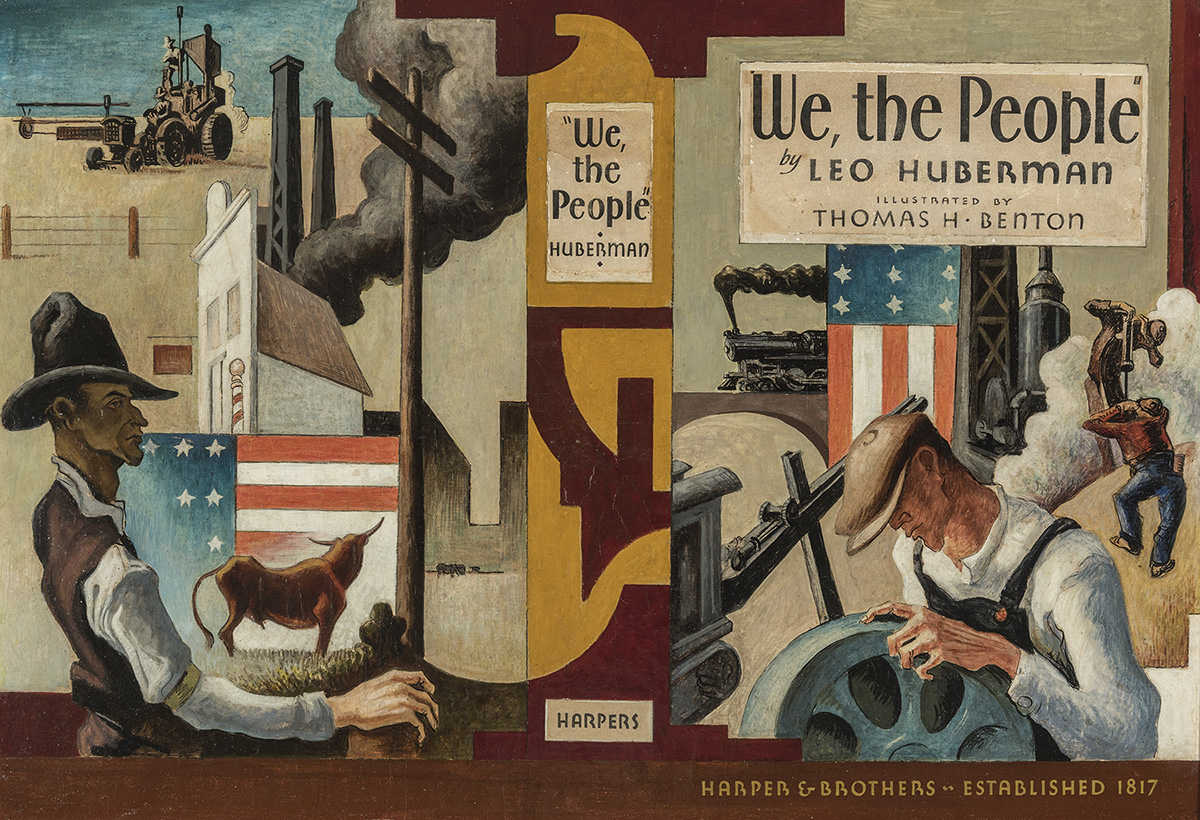
And here you have the locomotive probably going to close to 100 miles an hour which is the thing that’s making a connection across these spaces. And then you have these telegraph lines which are suggesting the way electrical impulses can communicate even more quickly across these vast distances. And I guess as I say art historians look at paintings probably differently than private collectors do. But I would have to say that if I was thinking of a cover for a survey of American Art this is a painting that I would consider seriously for that role. It seems to me it’s a wonderful sort of mythic representation of America and the things that are peculiar about America. This is the cover design for a book written by one of Benton’s friends Leo Huberman.
A book called We The People which interestingly given the view that Benton is often castigated as somehow politically reactionary it’s a Marxist history of the United States which is basically using Marxist theory to talk about the relationship of different regions and so for a thing is actually very illuminating if you want to understand this thought process that goes behind the mural like America Today. But this is one of my sort of favorite moments in Benton’s work where he has realistic imagery but is putting it together in a kind of quasi Cubist collage and even has a piece of paper that pasted on for the people title and this is a painting.
It’s easy to overlook. People often say that paintings representations of African-Americans are stereotypes and I think that if you just go look at the America Today mural you can see that that’s obviously untrue. An interesting why many African American artists such as Jacob Lawrence it seems to me do represent African-Americans in a stereotypical way. But if you look at the America Today mural I think one of the things that’s clear is that every one of those figures is an individual person who whose physiognomy Benton studied very carefully and there’s an extraordinary variety of facial types. And I think that this is it Benton clearly thinking back to people like Shaw for us when the guy who had represented the lives of French peasants.
But I think this is profoundly just it’s amazing how with such seemingly simple means Benton manages to capture what it’s like to be a downtrodden working person and to try to do that and retain your dignity.
I think it’s a very powerful painting. I’ve probably spoken long enough but I might mention I insisted and Andrew struck up was showing me some opinions this afternoon I insisted that he lose them out this evening is an extraordinary Winslow Homer watercolor which is very fresh in color and also one of the greatest watercolors that journal fresh ever did. If the Senate sees this or other organs of work done so I’m sure many of you know more about time start and then I do and I might say that one of my regrets is that I never met him.
I grew up in Massachusetts and if I knew him many years of my life I would be wasting writing at that time a certain point and I would have gone and asked him some simple questions which I’ve been unable to figure out. I have gotten to know Jesse Benton his wonderful character and um yeah quite an inspiration.
So I don’t know if any of you have questions, or those questions where it takes 20 minutes to ask the question . . .
[Audience member asks about the materials used in Benton’s America Today mural].
I am not going to try to explain all of that but I can explain the basic system. Benton liked to paint with tempera and I think there are two reasons for that. One is that Benton was a fast moving sort of impatient person and temperate dries very quickly. And the other is that he had looked at Old Master paintings and at some point it occurred to him that the older they were the brighter the colors were. And then he figured that the temper holds its color better than oil does. Most of Benton’s paintings are a mixture of tempera and oil glazes and basically the tempera provides the brilliant color and the large forms but if you put oil glaze over it you can get more subtlety in a richness of detail.
Generally speaking I would say that the earlier periods of the 20s and early 1930s don’t have too much oil that’s applied oil paint that’s applied to them but by the time you get to about 1939 when he did pour softening he became very interested in creating a greater intensity of detail. And at that point and I guess I’d say because it’s a mixed media technique you can have the same painting described by different people as a temperate painting or an oil painting or an oil and temperate painting. I’m painting basically used just said canvas over plywood. It’s something like the America Today mural has had modern restoration so that’s where the honeycomb panel comes from. People sometimes criticized Benton for not using a fresco technique. Basically when he was commissioned to do a mural he would create these wooden panels which were quite laborious to construct and then stretch canvas just that canvas over them and paint and temperature. If Benton had painted in fresco many of his paintings wouldn’t be around today. There’s something one of paintings murals since the 1930s that’s still in its original location which is a mural if he did for the state capital in Columbia Missouri or rather Jefferson City Missouri and something like you know America Today has been taken out the Indiana mural office and move to a new location mural he did for the Whitney Museum they sold for five hundred dollars to the New Britain Museum of American Art at a time when Benton’s work was very out of fashion.
[Audience member asks what questions Henry Adams would ask Benton if he were still around].
I might say that I just continue with that the conservation of Benton’s work is a little bit of an issue because tempera is a very brittle service so it picks up cracks. And that was noted early on with Benton’s paintings said that a lot of Benton’s artworks have cracks and there’s the potential of flaking out. Usually I think that doesn’t happen. Cracking up sort of allows a little bit of give so that it usually doesn’t like very much on the other hand I would say that five hundred thousand years from now when most oil paintings will have significantly deteriorated in color Benton’s opinions well all look just as brilliant as they do today and it’s always seemed to me that the cracking sort of goes along with fans who helped build a persona and you know that kind of energetic roughness that seems to have been part of his temperament. That’s obviously very sort of a hot button issue. Benton’s political background is very intriguing which is not untypical of coming from the south. His father my seen this Benton actually fought in the Civil War fought the Confederacy but then later made most of his money as a lawyer representing union soldiers who had pension claims. Jesse Benton was the daughter of Senator Thomas Hart Benton who was on the Benton. Great uncle or Senator Benton was Benton’s Great Uncle Jesse Benton married the Western explorer Charles Freemont who was the first presidential candidate to run on in anti-slavery platform. Senator Benton actually owned slaves but opposed the extension of slavery and was eventually defeated for re-election because of his opposition to the extension of slavery.
I mean you’re basically dealing with a highly argumentative contradictory cultural situation and I might say that Missouri was the center of warfare both before and during the Civil War. I think there’s no question that Benton was liberal on ideas about race and he stated that rather explicitly on a number of occasions when it’s an interesting footnote to his career is that he was largely raised by an African-American woman named Mariah Watson who was also the person who raised the African-American scientist George Washington Carver said that dealing with African-Americans was very much part of Benton’s daily experience growing up.
It is sometimes maintained that Benton caricatured African-Americans in his murals. It seems to me if you look at them that does not seem to me the case and it’s interesting to me that figures like Picasso who represented African masks as something, you know, violent and crude and primitive, are still people who basically had a kind of colonial view of Africa are still artists who are revered. It seems to me a lot of what the America Today mural is about is the fact that people in East Coast cities are relying on the work of people in the south and the West including African-Americans who are not getting we’re not getting very well paid or very well rewarded for that.
Interestingly in the early 1930s Benton attracted a large number of African-American students who worked with him at the Art Students League. That changed in the later 1930s and I’ve gone into that a little bit in my book Tom and Jack but basically Benton was quite early in his opposition to Stalinism. Now one is the can tenuous controversies about Benton has to do with the fact that he represented the Ku Klux Klan in his Indiana mural and basically he came in at a point when I think most of us are aware that at one point the clan dominated Indiana politics including the governor and the state legislature and they basically were defeated through an exposé by the press and the Indianapolis paper and Fenton basically is representing reporters in the foreground. Is an African-American girl getting hospital care and then there is a Klan rally in the background.
And if you want to pursue that I wrote an essay for something about it called The Conversation about that mural and then Jesse Benton wrote an essay which you can easily Google called My Father Painted the Truth, but she’s rather eloquent about the fact that in Kansas City at a time when it was a very segregated community. You know, her father would have things like African-American people for dinner at their home which is something that was not done in most families in Kansas City at that time and which caused a lot of negative comment. So it seems to me that this is something that people have gotten completely backwards and I think that at a time when Benton was viewed as the follower of abstract painting even though ostensibly you were supposed to leave biography out of the judgment or works of art. I think that there was a real very conscious effort to sort of vilify and defame him and very much the view that anyone here has a Southern accent has to be a bigot and that we can just dismiss people on that basis. So that’s the way I feel about it. Obviously all these issues about gender and race are very sensitive and you know it’s sometimes difficult to process to figure out what causes offense and whether that was intentional or. I think a lot of it just has to do with dating paintings and that kind of thing. And you know a new painting comes up and I’m trying to figure out where it fits in. And um yeah I’d love to you never know more about its relationship with Jackson Pollock and that kind of thing. Fortunately he was a remarkable writer and um at the time of his death was working on an autobiography called the intimate story where he gets into got quite intimate matters about his. The temptations in his family and so forth so that he is someone who’s left an extraordinary record.
[Audience member asks a question about Benton’s sketching practices].
That’s complicated but I think that there is some psychological and emotional element of it. And the turning point occurs in nineteen twenty four when Benton went back to Missouri to visit his father who was dying of throat cancer which of course is sort of strange cruel for someone who had been a politician. You know what. It had basically lifts were his words. But at that point at his father’s deathbed Benton had some kind of wish to reconnect with the world of his childhood. And in nineteen twenty six he took a walking trip through the Ozarks and then went out to border Texas and made drawings and then in nineteen twenty eight he basically set off with a student and left his wife for more than six months with no news about when he was going to come back and travel around the United States making sketches.
And that’s when he provided the basis for his America Today mural and I think that at some level he felt that there were things he wanted to express through his paintings that he couldn’t express in an abstract in a purely abstract language so I might say that I mean one of the interesting things is she did produce pure abstractions throughout his career. And um and was very encouraging. You know in the early phase as a career Jackson Pollock said. I think that one of the things Benton was trying to do in America Today mural was to combine modernist form in this sense of a essentially Cubist mode of—or it’s sort of a formal organization with Marxist subject matter said that he thought of himself as combining these two elements of modern thought – of course he later turned against Marxism because of Stalin, I think was and there you get into a very interesting thing because Benton’s father was a populist and a supporter of William Jennings Bryan.
And I could probably talk for an hour about populism and try to figure out what that’s all about. But it’s very much Benton. He grew up in a household which was very suspicious of corporate and government authority and had a sort of instinctive frontier rebellious stance to it. He was mostly in Paris and I’m just trying to remember that in more detail. He was in Paris. He spent the summer before he returned to the United States in the south of France. I don’t think he traveled outside of France when he was in Europe. He later in his life he went back and traveled but in France and Italy. But that was much later.
But he certainly knows about collage. And there must have been other people working with the assemblage at that point. I think it is interesting that Benton and we had a pretty informed understanding of modern painting particularly through the 20s. But I mean things he did in the 40s clearly shows the influence of people like Salvador Dali up through the late 1940s. I think Benton Stone regarded himself as a modern artist. And then of course after World War Two the whole climate changed and I mean it is sort of interesting. I think that when abstract expressionism came in it was almost like a Stalinist purge. And you know there was this great desire to get rid of these people. And I’m almost like that period in Russian history where you know there’s a portrait of Stalin with all his henchmen and then when sum gets axed out so you need to paint that guy out as a portrait of it maybe put someone else’s face in.
There was a fire that burned down in the family home in 1917. I was just going to say I guess I never needed time to start betting but I knew his sister Mildred Small and she vividly remembered for example a self-portrait he did in Paris which she said looked like a mule. And that she remembered as the first painting that she was ever interested in that most American paintings at that time were very sort of brand not very exciting to a little girl. But this was a portrait that really caught her imagination but unfortunately it was burned up later.
I’ve got copies of that essay say if you want to see it and it is hard to find. And Benton basically in The Mechanics of Form organization proposes that there are two ways of analyzing the composition.
And he proposes a method for doing it so you can take an old master painting and you can imagine it is a design on a flat surface and rhythmic lines which ends up looking a lot like a Jackson Pollock painting and you can also translate it into cubes which is a method actually used by an old master draftsman called Luca can be also if you use this method it was also used by door and other people and it’s actually a fairly hard kind of drawing to do because you need to basically look at an old master painting and conceptually understand that and not draw lines that you see but that correspond with where cubes are sitting in space. And if you do this exercise you start to see the rhythmic organization of the form and then in The Mechanics of Form organization Benton basically proposes different methods for doing composition. I might say that if you look at Jackson Pollock’s early drawings they basically follow this method of cubic analysis that taught him and Pollock was very influenced by figures like El Greco who had a great deal of rhythmic movement in their work. I did something I should have said is that interestingly Benton designed his paintings and clay models and his basic process for example with the America Today mural is he went out and did life sketches traveling around America. Then he came back and organized the life sketches into categories and so forth and made a claim model as his first integrated study of the design. He would then paint the clay model and do analysis of the composition both in color and black and white and then once the whole composition was worked out he would do life studies since the individual figures to work out the anatomy with more accuracy than he had been able to do in his life sketches. Interestingly Jackson Pollock arrived in New York in 1930 just as Benton was setting to work on his America Today mural and Pollock did what was called to action posing for the mural. And his words he basically posed for the figures studies for that mural and I can’t absolutely prove it but if you look at the figure in the foreground as the steel panel it looks very much like a portrait of Jackson Pollock. And in terms of understanding Pollock’s paintings it’s interesting that he not unlike copied painted in style but had actually been have figure within Benton’s major murals and within some of his major paintings it’s right.
Benton made them often plasticine clay and he would just break them up and get rid of them afterwards. At the end of his life a few of them were cast in bronze and there. I know of two models that survive in plasticine one for very light murals. There’s a painting at Yale. There’s a study for the plasticine and that’s it. The Milwaukee Art Museum, and four places, but mostly Benton had this sort of secret career as a sculptor.