
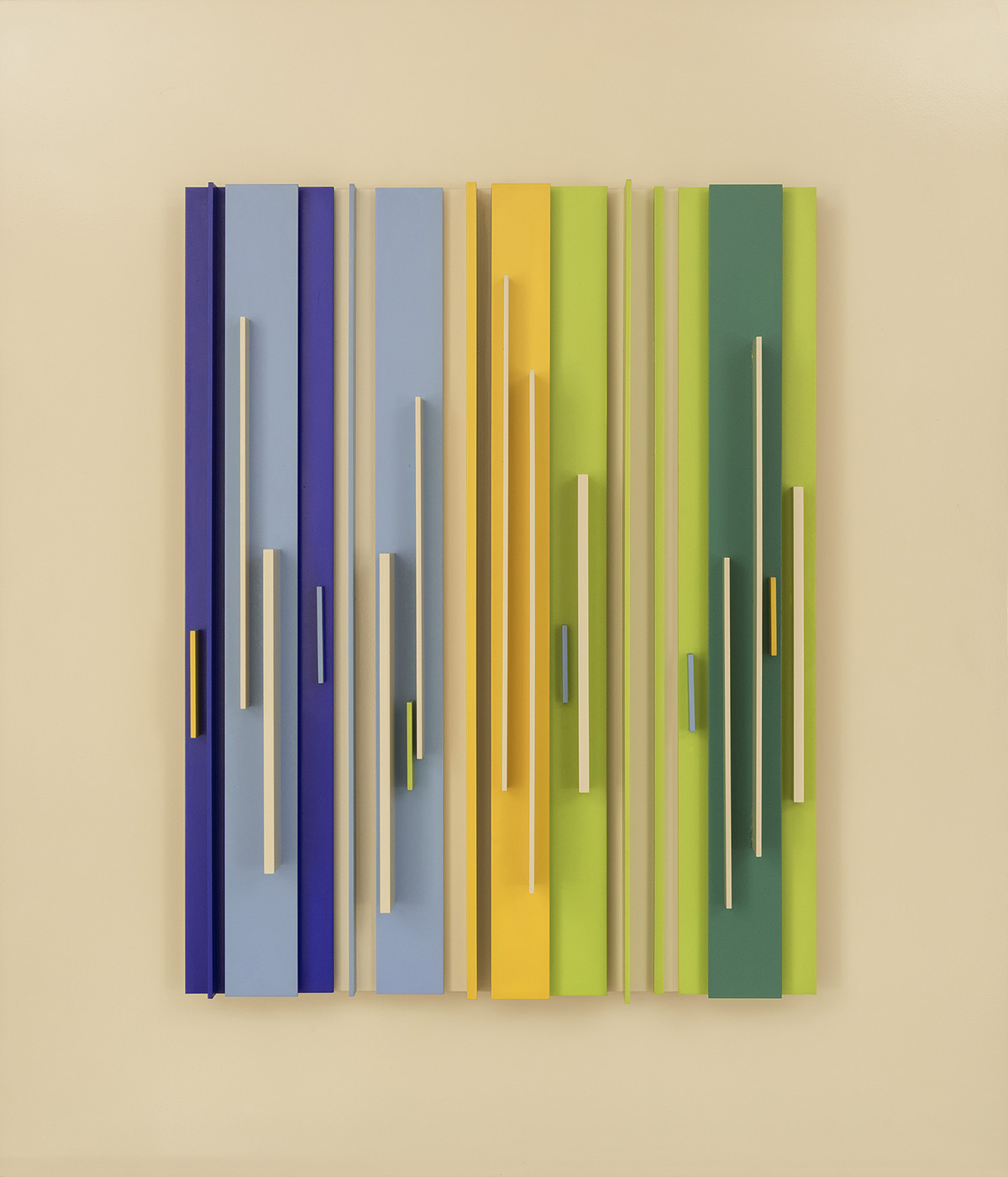
How much further from abstraction can you get than Fairfield Porter?
I’m surrounded by paintings and sculptures by Charles Biederman (1906-2004), but New Art City never sleeps and so my desk is cluttered with books on Fairfield Porter. I don’t think Biederman ever met Porter, and if they did, I’m sure it would have been instant and total and mutual enmity – but somehow they are all speaking to each other this evening.
Biederman was born in Cleveland and started as a Cezanesque painter in the 1930s in Chicago. Then he came east to New York, and became a sort of Surrealist. He went further east still, and found himself a disciple of Leger. You can’t pull a rubberband all the way from Cleveland to Paris without it snapping back, and that’s what happened, and then some, and by 1940 he wasn’t a painter and he wasn’t anyone’s disciple and he was living in Red Wing, Minnesota and that’s where he stayed. Around 1940 he predicted that easel painting had breathed its last, and he wasn’t wrong, but he was early. Five years a painter, fifty a sculptor: Biederman toiled away at wall-relief sculptures, abstract arrangements of colored rectangles of wood and metal, until the end of his career.
Biederman saw something deeply scientific about his rectangles though, and some scientists thought so, too. He became good pen pals with David Bohm, a physicist who liked what he did. Bohm saw in Biederman’s abstract play of shapes something science-like without representing science in some pedantic way. Biederman for his bit always said he was drawing ‘from life’ with his abstract pictures, and maybe it’s a vision of the life of quantum physics that Bohm and Biederman shared.
The year after Biederman was born in Cleveland, Fairfield Porter was born in Winnetka, Illinois. Porter went east too, but took a different tack, heading to Harvard and never kicking the oil on canvas habit. Some people just fall in with the wrong crowd, and Porter’s was John Ashbery, Frank O’Hara, and some other writers of note. You could say Porter’s work itself was literary, but that’s probably more to do with all the writers who found their way into his canvases. Really his work remained visual, and like with Biederman, not everyone could see the world the way Porter saw the world. And like Biederman, Porter knew it, and didn’t mind saying so. He too worked ‘from life,’ but Porter must have had a prettier life than the rest of us.
The two of them dug their ways into their work from opposite ends, one toiling at objectivity and making abstraction, the other toiling at subjectivity and making realism. Biederman wrote endlessly about what he was doing, but I think Porter understood the both of them better than either one of them understood themselves.
I came across a talk that Porter gave, and I transcribed the best parts for you to read while you’re at work, so you can decide for yourself:
“Maybe I looked for the idea I already had . . . I wanted to somehow relate everything that I said to students. I think my idea, that I am interested in, it’s something that doesn’t come from artists or art students questions, but it’s something that comes from comments by laymen . . . One of the questions that perhaps that perhaps bother some students, not the best ones, necessarily, is, I think, what is the meaning of what they do. I think discouragement comes, people think, Well I’m doing this, what’s it’s all about? And I think that wondering what something ‘means’ comes from the influence of our environment. We’re asked that now that to study art has become more popular, and we’re influenced by the prestige of science. There’s a difference between art and science and it’s an important one.
“The difference between abstraction in science and abstraction in art: Science is concerned with the general, with explaining, and meaning, and science has influenced writers particularly, and critics . . . and they write about what different art movements mean. They try to apply science to art. When science explains, when it gets to something general, it goes away from the specific . . . it emphasizes the way things are alike. A scientist explaining is also translating – he’s saying, this and this and this phenomena can be explained the law of gravity, Einstein’s theory of relativity. What a scientist means by communication . . . that he can translate phenomena into a verbal explanation. The limitation is that any explanation doesn’t explain; an explanation is actually impossible. An explanation takes you away from the concrete event, and gives you a . . . generality. That is a little different than experience.
“Science has another side, that it is based on experience, that it is experimental, that it is experimental, and the philosopher of science. Art does not look for; art does not explain. To explain art is to get away from art . . .
“I don’t believe that there’s anything important in the distinction between abstract art and realist art. What’s important is that it looks for difference” [Maryland Institute College of Art, 1963].
If that explains the mountain that the two artists were drilling into, one more artist talking about art can bring them back together. In the 2000s, John Chamberlain said in a talk that he didn’t know the difference between abstract art and realist art. All art is by its nature abstract: it’s a picture of a car, not the car itself. It’s all abstract—just an idea, hinted at. Unless it really is the car, and you put it in a giant trash compactor and sent it over to Pace for display.
I can’t find the citation but it was on a DVD that came with a book that Pace put out, and I lost the book and don’t have a DVD player anymore since I just stream, but that remark always stayed with me. I like to think that all three of them, Chamberlain, Porter, and Biederman could be great studio mates up in some astral plane or afterlife somewhere. Porter painting from the model, making the colors too vivid and a little “paint-by-numbers”; Biederman cursing everyone out and telling the model to sit still as he assembled an inscrutable pile of brightly-colored rectangles. Every now and then, John Chamberlain comes along, takes a Biederman aluminum sculpture and crushes it in a giant trash compactor.