
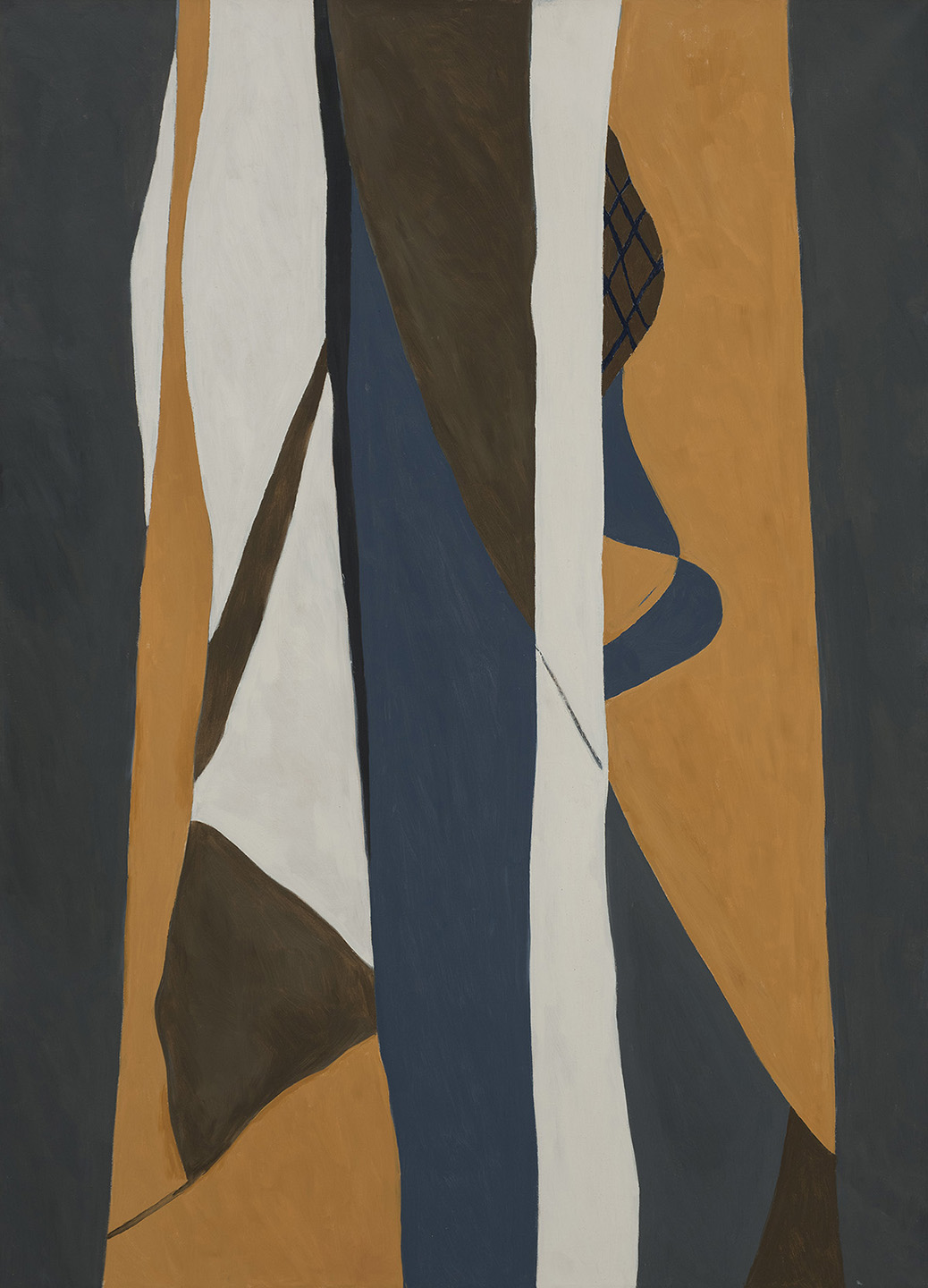
We’re in something of a Ralston Crawford literary Renaissance. I’d say, “It’s about time,” but that’s a peculiar thing: some four decades after the painter-photographer’s death, why now?
Some careers, especially long ones with twists, take a little distance to come into focus, of course. And some take a shifting landscape of taste to be accepted into the firmament, or just an opportune moment to be rediscovered —like Hilma af Klint or Vivian Maier (the question was once asked, with withering irony, ask why there are no great women artists; there’s been a small but meaningful shift in the barometer of justice that even that provocation seems jarringly retrograde today). Still others find a reappraisal fueled by commerce: ‘We used to think that Picasso got bad at the end,’ a dealer once told me. ‘Now,’ that there’s nothing left but the late material, ‘we know how great he remained.’
But Crawford has none of these. A Canadian by birth, he travelled extensively, made prints, photographs, drawings and paintings, served in the military when called, lived a good and reportedly happy life, albeit possibly shortened by unsafe exposure to nuclear radiation when observing the atmospheric test of a nuclear weapon. He had early success, sold well throughout his life, had a family and was, as a recent book declaims, ‘an artist’s artist.’
To be clear, the question isn’t, ‘Why a Crawford Renaissance?,’ for his work so richly deserves it.
The question is: ‘Why now?’
Crawford’s work enjoyed the coffee-table treatment in the artist’s lifetime, in the form of an oversized book on his lithographs [Richard B. Freeman, The Lithographs of Ralston Crawford, 1963, University of Kentucky Press], and, a few years after his death, a big book on the paintings [William C. Agee, Ralston Crawford, 1983, Twelve Tree Press, Pasadena, California]. A slimmer volume, 1953’s cloth bound edition by Freeman [Richard B. Freeman, Ralston Crawford, 1953, University of Alabama Press, Birmingham], serves as a mid-career catalogue raisonne. In 1985, Crawford got The Full Whitney, with extensive retrospective and monograph by Barbara Haskell [Barbara Haskell, Ralston Crawford, 1985, Whitney Museum of American Art, New York].
The last few years have been a crescendo of printed pages. All have accompanied exhibitions, but they haven’t been blockbuster shows at international-tier museums. But they have presented extraordinary scholarship, shine light on different facets of the work, and each has been beautifully designed and produced. It’s an important thing: a catalogue of an exhibition will have a life beyond the show, and if the museum is, say, a modest university organ in a remoteish plains-state and doesn’t travel, the book may be seen by many times the number of people who see the show.
I missed Ralston Crawford: The Artist’s Eye at the University of Wyoming [Susan Moldenhauer and Nicole M. Crawford, Ralston Crawford: The Artist’s Eye, 2014, University of Wyoming, Laramie], but the accompanying book is a fresh look at Crawford’s work across media. The show presented Crawford’s work in film, and makes use of QR codes to link back to multimedia presentations on the museum’s website—a grand use of modest technology, decidedly not at the Whitney’s disposal in 1985. The films – whether projected on a screen or popping up via QR on your smartphone, are mesmerizing. Just when you start to get bored by the incremental creep of a shadow across a wall, the slow wave of band of paint reflected in the surface of a lake, you realize you’ve never seen anything quite like it. They play on that very delicate space between abstraction and observation. The standard narrative has been that Crawford used the films and photographs to make paintings, but, standing hypnotized in front of the films recently, I felt the script flip. The films don’t serve the paintings; the paintings reach outside of time, vibrating a little as they try to emulate the bending permanence he found through film.
Ralston Crawford and Jazz [Olivia Lahs-Gonzalez, John H. Lawrence, Ralston Crawford and Jazz, 2011, Sheldon Art Galleries, St. Louis] brings back to the fold a body of work that was thought to have wandered off: his anthropological photography. When Crawford started taking photos, in the mid-1930s, they were an aid to memory and a tool to re-visualize the quotidian. In the service of his cross-media aesthetic, they left out the same thing that vanished from his paintings in the 1940s: people. I know off hand of two paintings with people in them, both taken very directly from photographs, both from the 1940s. Revel in them, because after that, you’ll never see another human form on canvas. Broadly speaking, the fine art photography follows suit. But here a division insinuates itself, because there’s a whole body of work – perhaps thousands of negatives, and certainly hundreds of prints – capturing nothing but the human element. From the straight portraiture of jazz musicians, many of which were bought for reproduction by a jazz record label to a simple documentation of life in the streets of New Orleans. The Sheldon exhibition herded these William-Klein-esque street photos with the Aaron-Siskind-esque abstractions, to remind us of the cool-jazz swing that hums through all of Crawford’s painting. You can sense the melody of even his most abstract pieces, but expressed through improvised color and form: Ralston Crawford, kind of blue.
Last year, the Nelson-Atkins published a book on Crawford’s photography [Keith Davis, The Photographs of Ralston Crawford, 2018, Hall Family Foundation in association with Nelson-Atkins Museum, Kansas City] that is simply the most beautiful book on Crawford, in any media. Keith Davis’s incisive text built on what I suppose by now is being cemented as critical consensus: to get Crawford, you have to take in all the material, across media. Running through the titles of books on the artist, I noticed that they never mention a medium: either the primacy of painting is assumed, or the authors and curators are gently moving toward omnivory. Keith broke rank and wrote putatively about the photography, but his text keeps re-contextualizing the photos in terms of paintings, prints, and drawings. While the focus is narrow, the understanding has never been so broad – a view I got to share with an audience on stage at the Nelson-Atkins with Keith in March. It’s a handsome book, and it lets the photos shine as they never have before. If you think of the photography as a little Siskind with a little Walker Evans with a little Bechers with a little Strand and Sheeler and a twist of Weegee for good measure, you won’t be wrong. But you’ll see something else emerge from Davis’s curatorial effort: the same eye that searched the canvas for dynamic forms found them through a viewfinder.
This month, the bar is raised on that beautiful book, with Ralston Crawford: Torn Signs [William C. Agee, Rick Kinsel, John C. Crawford, and Emily Schuchardt Navratil, 2019, Merrell in association with Vilcek Foundation, New York]. The title riffs on the cross-media nature of Crawford’s working methods: he tended to explore a single subject in a variety of media, and perhaps its more fruitful to think of his work organized around these nodes. Public posters, signs, and advertisements make up a single motif that he explored in prints, drawings, paintings, films, and photographs, and viewing that corpus together makes more sense than the desultory hopscotch of reviewing his photography alone as a single body of work. The Vilcek Foundation show obviates the pesky problem that the Sheldon grappled with mightily, choosing a single subject of focus and digging in deep.
The result is euphoric.
The paintings and photos start to talk to each other, yielding strange new associations across time and subject matter. That conical form he painted in in New York in 1954 pops up again in a photograph from Seville, Spain two decades later, as if, like a physicist, he had postulated its existence long before discovering it outside of laboratory conditions. Through examining the part of his career, the whole starts to lurch into clarity. From the noble gases of the precisionist paintings of the 1930s to the radioactive isotopes of the war years to the
In five years, four major books, each great, each more beautiful than the last—and, gratifyingly, with very little overlap.
The reason for the Renaissance is as varied as Crawford’s life: He studied in Los Angeles, made prints in France, paintings in his studio in New York, taught classes in the South, took portraits of jazz musicians in New Orleans, observed the devastation of nuclear weapons in the South seas; and took photos everywhere from Seville to the Gulf of Mexico to the Grand Coulee Dam. His work was as well-travelled as his eye was focused, and he’s being celebrated in this moment for those many points of contact. Crawford’s appreciation isn’t New-York-centric because Crawford’s world and his art weren’t New-York-centric. In spring of 2019, you can see a major exhibition of Crawford’s work in Kansas City (at the Nelson Atkins, curated by Keith Davis), in Palm Beach (at the Norton, curated by Ellen Roberts), and in New York, at the Vilcek Foundation, curated by Emily Navratil.
It’s about time!