
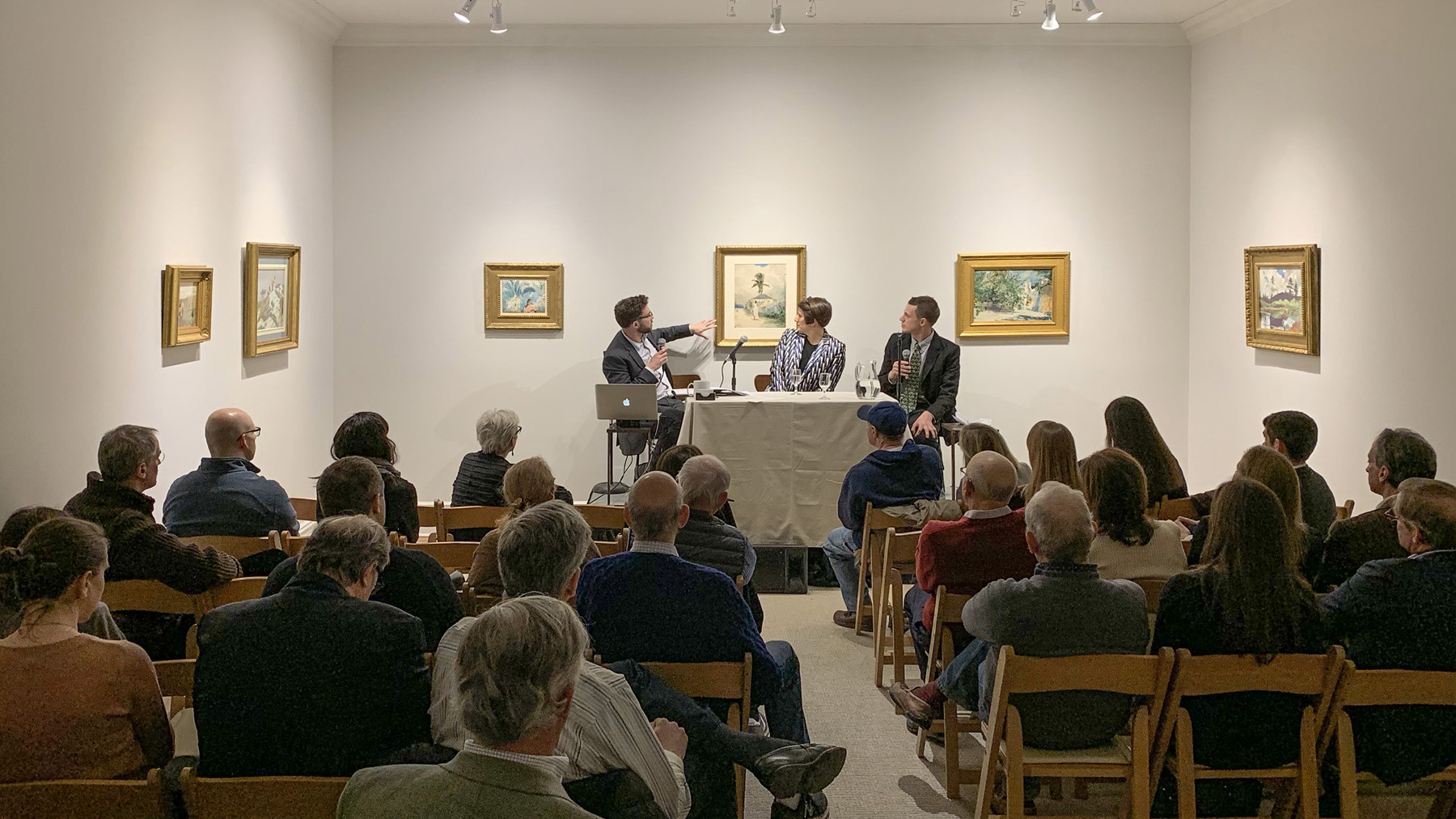
On Tueday, March 12, 2019, Menconi + Schoelkopf hosted our first in a series of talks that we’re calling “Pop-Up Symposia.” Volume I featured the Metropolitan Museum of Art’s Stephanie Herdrich and the Hudson River Museum’s Theodore Barrow in a conversation about Homer in the Tropics, with digressions on who was better, Sargent or Homer; how to make an alligator reveal its vulnerability; and the Boer War. A few excerpts from a great conversation, moderated by Jonathan Spies:
Jonathan Spies [00:00:22] Hassam and Sargent and other people in Boston who are definitely you know impressionists but also have more or less contemporaries of Homer doing similar things but just looking at some of these pictures these are so far from Haas and these are so far from Sargent Homer goes to Europe and ostensibly could have been exposed to a lot of things that Sargent and Hassam and other folks were exposed to. He seems to have learned nothing about like impressionism or at least doesn’t hold onto anything as far as I can tell. Homer from another planet. What is he doing?
Stephanie Herdrich [00:01:09] Well I do think as we sort of in our emails talked about you know there’s a generation difference between them. Yeah. So Homer is born in eighteen thirty six and Hassam is born in 1859 and I do think that’s a crucial difference that generation. Those you know Homer I think is so lucky they have a lot in common they’re in Boston they’re essentially self-taught they’re cobbling together the different kind of resources in Boston to create and form their own artistic education. They have parents who encouraged their interest in art. But Homer I think is so shaped by the Civil War and Hassam is born in 59 and he’s still a child and has really different opportunities. I think we all know that Homer begin and has and they both begin their career as illustrators. Homer becomes a painter during the Civil War and he actually travels to the frontlines in Virginia and is embedded with troops. And you know there’s we don’t know so specifically specifically about everything that he saw but we know when he returns his mother says that he was so changed. Even his closest friends didn’t recognize him. And I think that you know if I’m speculating. I mean I think that Homer. I would guess that he had a form of PTSD from what he saw during the war. I mean all Americans who lived through the Civil War which was obviously the most bloody and terrible war have to reckon with that in the years afterwards and having seen people die in battlefields. That’s something that’s deeply embedded in Homer’s psyche. So when he travels to Europe. Ahead of the Impressionists he’s looking at a much more kind of traditional education he’s looking at barbers on painters and you know Hassam does some of that too. But Hassam is in in Europe in 1883 and then again in 1887. So he really has more contact with the Impressionists. He travel he’s there much longer. He travels spends a lot of time in the French countryside. And I don’t. Think he feels the burden of the civil war in the same way that Homer does.
Jonathan Spies [00:03:33] I mean it’s interesting because Homer I mean as you say everybody of a generation who was around the civil war must have been deeply impacted by it. But there’s almost nobody else who almost nobody else who really reacts on canvas to to the civil war. And you know there’s sort of allegorical readings that you can find in Martin Johnson Heade and other landscapes and like that. But. But you know prisoners from the front veteran and you know feel these are really direct. Reactions to the civil war that you just don’t get from virtually anybody else. And so then you see you know the rest of his career you can sort of look at as a as a reaction or like mediation on that. And so just some of these pictures that we have almost this this little watercolor over and the right is called boys on a hillside and it’s got just two youngsters you know lay out frolicking in nature but there’s also I don’t know there’s something like he’s his preference for you know looking for lost innocence or something like that. It seems to be a major theme throughout his career.
Stephanie Herdrich [00:04:50] There’s just there’s always this stamp of the Civil War on on Homer and I think you see these echoes across his work as we’re saying. Like the painting like that picks up on themes that are in veteran and a new field the sadness the loss of the Civil War the devastated landscape the boy seen from behind kind of representing a more universal sentiment. And you know Homer as we all know kind of reiterates and explorers and re explores themes over and over in his career right.
Jonathan Spies [00:05:46] How broadly to look at the pictures in the tropics? As are they sporting pictures? Are they genre scenes? Are they anthropology, or you know what’s the—how to fit Homer in that moment, in the Bahamas and in Cuba. They’re just really strange pictures. I mean this right behind us is a fantastic example but it’s kind of an interesting outlier both in his work and in American art.
Stephanie Herdrich [00:06:27] Well I think that there’s a lot of impact in that question. One of the things that interests me is and it’s something that I did for many years to which is we kind of lumped the tropics together. And I think if we dissect the different trips and look at his Bahama works versus his Cuba works versus his Bermuda works we see that they are distinctive also. He’s his work. I think it’s transformed by the tropical light. So there’s a great advance in his watercolor technique but that there are kind of specific subjects that he explores in each of the different places and in the Bahamas. He’s really I think beginning to look at the lives of the local people and he’s thinking of a post slavery economy and the lives of these formerly enslaved people of African heritage. And what happens after slavery. This is something that interests him in the United States of course when he returns to the reconstruction south and paints a series of pictures. So that’s a theme that interests him. But I also see it kind of connected to like the color codes works in a sense which are painted in the years right before the Bahamas where he’s looking at the lives of these women and their daily life. So there’s a kind of continuum but also a kind of new exploration of themes. And then you know Cuba for example he’s so interested in the colonial the Spanish colonial past and he looks at the architecture and you can see from the watercolor here of the woman with the fan he’s really it’s the Spanish costume. That’s very prominent there and Ted we were talking about the sort of architectural interests in Cuba.
Ted Barrow [00:08:11] Well I think I agree with everything that Stephanie said about Homer’s continuation of certain themes and motifs. I also think that it’s interesting when he first goes to the Bahamas. He’s traveling with his father. His mother had passed away in April of that year. They leave in December as the middle child. He’s alone. It’s his duty to take care of his father and his father was pretty flamboyant and profligate pretty wasteful and you know it’s like an exaggerated version of love as Homer spent more time with him. Homer’s worst quality is he would complain about him all the time. So he’s you know it’s no surprise that he doesn’t depict his father or the Royal Victoria Hotel which was the biggest hotel in Nassau where they where they stayed. Instead he takes trips to Fox Hill which was the former slave neighborhood that was where the most of the Afro Caribbean bohemians lived and depicted oceanic dark skinned women children and sponges fishermen. And strangely enough I see a very interesting relationship between their work as laborers and an almost inverse reflection of Homer’s own identity. He never paints people that belong to his own class. He never paints himself, his father has. I mean he will paint portraits of his of his brothers or nieces nephews. But these are people that are shut out from walls. These are people that carry tropical fruit. These are people that work as that Labor on the sea. And I think that in painting the other you are finding a reflection of yourself in a way. So I mean it’s you know of the Afro Caribbean subjects of women walking along roads they are quite often cut off by a limestone wall from a lush tropical garden. They’re often carrying fruit. They’re often carrying chickens there. They’re at work in the same way carrying things that Homer also paints and is planning to sell.
Jonathan Spies [00:10:29] All right. We have oranges over here. This is you know something he’s focused on and even just the cropping of this picture over here is just you know there’s almost like a picture frame gives us a sort of wall separating us from the subjects as well as I had just found some quote from Sargent where he’s talking about. He’s just working in watercolor is making the best of an emergency. And I stumbled across something elsewhere. When he when Sargent was down in Florida he seems not to have come very prepared like he writes to a friend or somebody in the studio is like hey set me down some watercolor paper I should probably be painting while I’m here like he just hadn’t thought of it or something. And it just highlights quite a different a different attitude towards art making that the two had. But Sargent is down in Florida and there’s some stuff in the tropics. You’ve both done a lot of thinking about Sargent as well. My sort of outsider perspective is that Sargent is definitely an impressionist when he’s working in watercolor but in oil sometimes not so much like he sometimes has a much more static view that makes me think a little bit more of Homer more consistently. What what to make of this whereas the how do how does Homer relate to Sargent. I don’t know if there’s a if there’s something about the tropics that impacts both of them.
Stephanie Herdrich [00:11:59] Well I think to say first that Sargent goes to Florida for 1917 because he has a portrait commission. And by 1917 he is not interested in painting portraits anymore. So this is a burden to him. He is sort of like God I can’t believe he. It was a fundraiser for the Red Cross and he goes down there to paint John Rockefeller’s portrait and he is not happy about it. And he does kind of complain and he says there’s nothing to pay. But then once he starts painting I think he’s pretty prolific and excited about it. But I do think about Sargent as a watercolor painter is that he’s the master of making it look easy but he’s put a lot of effort into it and I’m going to give a shout out to the Met’s paper conservator Marjorie Shelley who with whom I worked with for so many years and who has taught me so much about looking at watercolors. But we did a catalogue years ago of the Met’s Sargent watercolors and she did great examinations of the watercolors using infrared reflector graffiti to look at the under drawings and what we found is that many of them had these completely thorough under drawing. So very premeditated measured he’s using rulers or a compass. So in some instances but then his brilliance is that he comes in and he makes it look like he dashed it off in 10 seconds. And obviously there is an expediency of watercolor right. That fluidity and you can’t make mistakes but he’s kind of fooling us into thinking he’s an impressionist whereas do you want to talk about Homer’s watercolor.
Ted Barrow [00:13:40] Yeah I would consider Homer much more of a realist in that if we’re going use that. I mean he was accused of being an impressionist by American critics but their understanding of Impressionism in the 1870s and 1880s was different than how we think of “impressionist”. It was an insult. I would think that with Homer he’s scraping away figures and there is a bit of spontaneity but it always seems much more pent up in tightly composed in the way, like comparing Corbet or Millet to Manet or Monet. I know I’m mixing impressionists and realists but you know it’s a similar relationship but again in the tropics and in Florida particularly about six and a half years after Homer’s death I think that Sargent is in a mode where he’s thinking of himself as being an American artist and he is painting these watercolors with Homer in mind so in and I don’t think the artists are aware of one another in their lifetimes when their lives overlap. I’ve done a little bit of research; this is my conspiracy theory. Might as well just share it with everyone. Sargent’s first. The first painting that Sargent shows in the States at the Society of American artists in 1878. A sketch of the oysters gatherers that—I can’t recall the name of the critic, but describes Sargent as “exquisite nothing short of exquisite.” And then Homer. Across town at the National Academy is showing his two guides. That very same critic who talks about how an exquisite Homer’s two guides uses that word. And so I think probably that stuck in Homer’s craw. Starts to move more into working more actively with dealers doing scenes in color coats which I think in some ways resemble what Sargent had shown in the States at this at the Society for American artists so. So I think that there is an interesting relation push and pull there between these two artists. And I don’t know if Homer is thinking of Sargent in the tropics but I would guess I would bet that Sargent is aware of Homer while he is in Florida. Do you have a pet conspiracy theory.
Stephanie Herdrich [00:16:33] Yeah I think I mean it’s you know they’re set up very early on by the critics as the kind of the in their lifestyle. Sargent is the cosmopolitan European trained and Homer is the American. And Henry James is another one who writes about both of them early on. And of course James is just enchanted with Sargent and he likes Homer too. But he talks about his ugly milkmaid. And you know the plainness of his subjects. So they’re set up very early on by the critics to have this kind of dichotomy which are at extremes which I mean the reputations that lasts until today I think you Sargent is the cosmopolitan Homer’s The American and in the subjects they painted and the people they represent. I mean Sargent when he goes down to Florida he finds he works at Palm trees which Homer obviously like he also does those alligator paintings which are so I mean there’s this exotic quality to them which is pretty over the top. I feel like Homer have painted those pictures. I don’t know if that’s right.
Ted Barrow [00:17:38] I don’t think he would have painted them in that way. But he met Homer does painting scenes and in the swamps involving reptiles and an exotic fauna.
I think I think Sargent is well—first of all, Henry James goes to Florida to you know it’s just like that. What’s interesting about this my topic I think is everyone goes down there and they all think about it. And before Homer Goes there you have Martin Johnson he’d you have in his wintering in Florida Thomas Moran goes to Florida and they painted in this picturesque and sometimes romantic mode identical pastoral. Both Homer and Sargent don’t look away from modernity you know their bottles floating and in the water and channel bars their Sargent is painting development in the background and his portrait of Charles Deering. And so I think that on that realist approach to painting Florida is something that links them and not many American artists at that time are doing something else but I don’t want to ask you Stephanie about this sort of the the gender or sexual politics of Homer and Ted touched on this a little bit but you have this these sort of I guess there’s racial politics as well.
Jonathan Spies [00:23:13] I just had a few more questions but one of these was just who do you like better Sargent or Homer.
Stephanie Herdrich [00:23:22] It’s like you know when your children say ‘She’s your favorite!’
Ted Barrow [00:23:28] I think since we’re spending time with Winslow homers I’m going to side with Homer but if there were just as many, an equal amount of Sargents I would I mean it’s for very different reasons it’s oranges and palm trees. It depends on what you want to look at. Do you want to look at Delacroix or Ingres. You can . . .You can enjoy both.
Ted Barrow [00:25:20] What draws me to Homer is there’s always this diagonal pull in and out of each of his images are you can almost feel the pull of the canoe as it as the like visually dire. Yeah right. But also just in terms of like force often I find as much as I love Sargent’s watercolors and is as oil paintings. He brings everything to the surface. You know he’s really interested in camouflaging in a way that that I don’t find happening. Interestingly enough he works with there on you know sort of these ideas of camouflage at the beginning of World War One and just you know Sargents use of lead based white paint which of course was necessary at the time. That was how white paint came out it really gives a materiality to parts of the surface of his canvases that maybe shouldn’t. I was just at the Met I think I still have my sticker somewhere looking at the Hermitage it’s all the trio and just the way in which that body materializes into the background something Homer would never do. It’s a different kind of interplay between like the surface painting the plane of the picture and the space suggested within I don’t know if it’s choosing sides.
Jonathan Spies [00:26:45] No we don’t have to fight that battle anymore. Just getting back to the Alligator pictures. Your remarks about camouflage and surface. Really bring that to mind because that’s something else that we’ve talked about in the past is that you have these menacing creatures you know that Sargent is just lavishing all this tactical proficiency on and seeing them in person it’s like all these little. It’s like everything you could do with a watercolor you know using reserve using gum Arabic to pull back to white and that’s scratching into everything you could do with a watercolor is in those pictures. And there’s something that’s just not very actually frightening about them because they’re so luscious. Yeah. You just want to sort of enjoy this. The surface quality to them which is which is interesting and I feel like there’s not even just little things like this. I’m not sure what the narrative is here. There’s some sense of maybe that menace but there’s a there’s a sense of investment and maybe not danger but something risk in this picture.
Ted Barrow [00:27:56] So yeah I think one of the things when he first starts painting homemade imagery and palm trees Homer often is like painting tropical storms and just the sway of that palm tree and the direction that the that the fronds are blowing and you get this sense of you see steamships on the horizon you see all the older ships in the water the sense of both kind of solitude in that figure but also this very fragile world that just someone coming from the Northeast must have looked very quickly built in very vulnerable. I mean you know taking ward lines steamship down in four days from New York’s harbor and ending up in NASA seems like a very some culture shock happening there.
Jonathan Spies [00:28:46] And indeed there were there was some vulnerability right. So I’m sure. And I don’t know what you’ve what you’re drawing into your show but he does all these pictures of you know like after the hurricane. And you know that just the devastation of course the vulnerability to nature that sort of thing.
Stephanie Herdrich [00:29:07] I think in these watercolours in particular of the tropics for Homer there is a there is a tension between that kind of beauty of them and the setting and often the sunlight. But then there’s a menacing quality to nature and there’s always a kind of disquieting sense that you know this storm is coming or it’s passed through the trees or blowing their scenes of shipwrecks. There’s sharks circling derelict vessels. You know that if we they can be very sunny and bright but there is still this kind of dark moodiness in them that and a kind of atmosphere not just a weather atmosphere but that kind of a somber mood that can permeate them.
Stephanie Herdrich [00:30:03] Homer returns to the region again and again. So I do think it sort of infiltrates him and I think that he has a sense of. Obviously he respects the sea and the power of the sea. But he’s thinking about the Gulf Stream. The tropical current and I think he develops this really kind of sense of the ocean and I kind of think the current of the Gulf Stream as a link between all of these places that he paints so he’s very connected. He see you know he’s painting in the Florida Keys where you know sort of where the Gulf Stream begins and the region wraps around the Bahamas and Cuba up the coast all the way towards Maine and then across the ocean to England. I mean these are all the places that he paints and that he loves to paint. And I think that he’s making this connection to the ocean to the current and the power of it. And that’s a way that all of these things end up connecting in his work so that you know the vessels the sailing boats in the Bahamas are have connections to the lives of the north New England fishermen working.
Theodore Barrow He paints portraits of his brothers. He paints caricature. He draws caricatures of his father really humorous ones and he paints the portrait of Helena decay which was one of these possible objects of love interest or longing for Homer in the early 1970s. Interestingly enough one of the watercolor sketches he does of her pregnancy does she is carrying a fan. And so I’m very interested in what drew him to fans besides their wonderful compositional potential. And in the Spanish girl with the fan. But in most cases I think many of his models are identifiable if they’re but they don’t really serve as strict but like portraits in the sense that Sargent would paint portraits.
Stephanie Herdrich [00:32:00] And I’m also thinking of when we talk about the Civil War works for example a work like veteran in a new field where you don’t see the face and this figure is seen as kind of every man every veteran on the other hand you have a painting at the Met like prisoners from the front where which it shows. I don’t know what his office was Francis Channing Barlow is he General General shows him with a group of prisoners and it’s a very specific portrait. So Homer is kind of genius at sort of blending the kind of specific details making them more universal. So painting like prisoners from the front has very specific portraits of individuals but it’s sort of or character or car right. Well I would argue that in a way it it it transcends the specific portraits to become a painting that encapsulates the whole conflict of the war between north and south and the different kinds of soldiers. So there’s again this kind of wonderful tension in his work between in this case the sort of specific identifiable and the broader theme.
Jonathan Spies [00:40:14] Just to wrap up are there any upcoming shows not at your respective institutions that you’re not working on that or other interesting things that you want to play that you’re excited about personally. It could just be like Game of Thrones.
Ted Barrow [00:40:29] I’m very excited about Game of Thrones but I’m also here. Since I’m not working at the Met I’m very excited about Stephanie’s upcoming Homer in the tropics show of course.
Jonathan Spies [00:40:43] And when does that actually when should we expect that 2020 to spring –
[Microphone falls to the floor with a loud bang]
Stephanie Herdrich [00:40:59] Mike drop!
Jonathan Spies [00:40:52] That’s not what that means. Spring 2022 that’s what we have to look forward to mark your calendars.
Stephanie Herdrich [00:40:59] There’s a bunch of good things coming up and there actually is going to be a small but looks interesting show at the Cape Anne Historical Society this summer about Homer and the sea and they’ve gotten some really good loans. I’m going to be I think a nice group of watercolors and oil sketches so if you’re up at the beach and then this fall there is going to be a surge a show of Sargent’s charcoal portraits at the Morgan Library. American Pre-Rafaelite show at the National Gallery in Washington opens in a few weeks.
Jonathan Spies [00:41:34] Awesome. Thanks so much guys. It’s been really fun talking to you.