
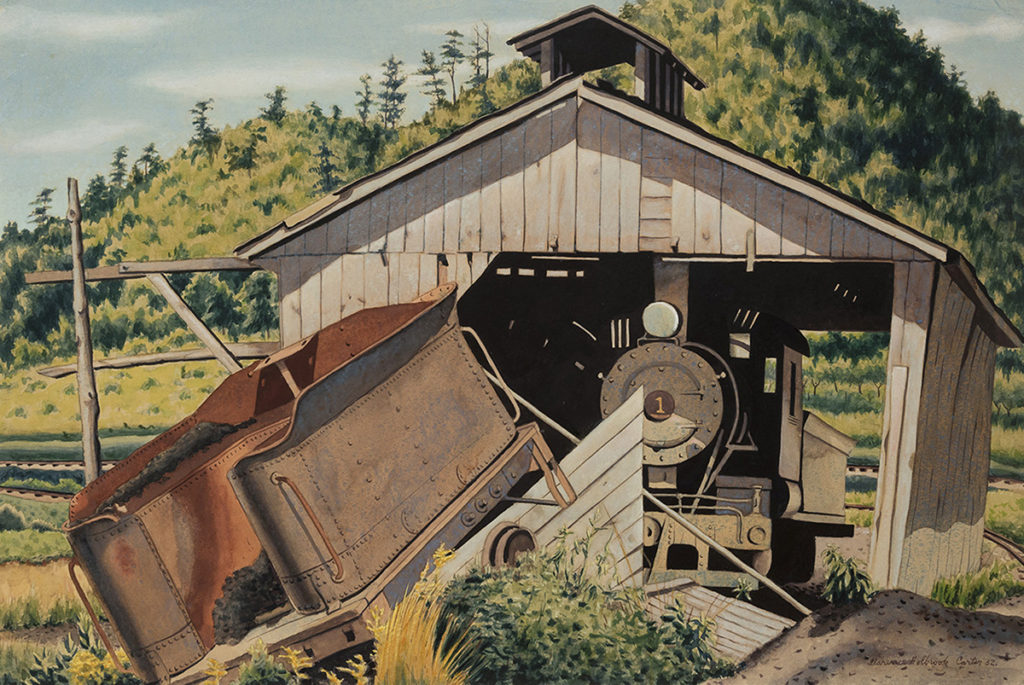
Triplet Creek Special, 1932
Clarence Holbrook Carter was born in Portsmouth, Ohio in 1904. His pre-War watercolors are associated with the American Scene Painting, while some of his post-War work is associated with Surrealism and Magic Realism. His watercolor technique employed quick color washes and little retouching. Speaking on his work, Carter once said, “for me, no great art has ever existed without some mystery and some awe.”
The Ohio native began painting at six years old and received recognition for his art during his childhood. Carter enrolled at the Cleveland School of Art in 1923 and received patronage from the director of the Cleveland Museum of Art, who sent Carter to study in Capri, Italy with Hans Hofmann once Carter graduated in 1927. In 1931, Clarence Carter participated in an exhibition in New York, which also showed the work of Charles Burchfield and Edward Hopper. Throughout the 1930s and 1940s, Carter’s early work consisted of large architectural paintings and symbolic landscapes that depicted the rural American scene during the Great Depression. After World War II, Carter shifted to a more abstract and surreal style of painting that featured fantastical creatures. Beginning in the mid-1960s, his subject matter changed yet again, favoring hovering ovoid shapes with eyes.