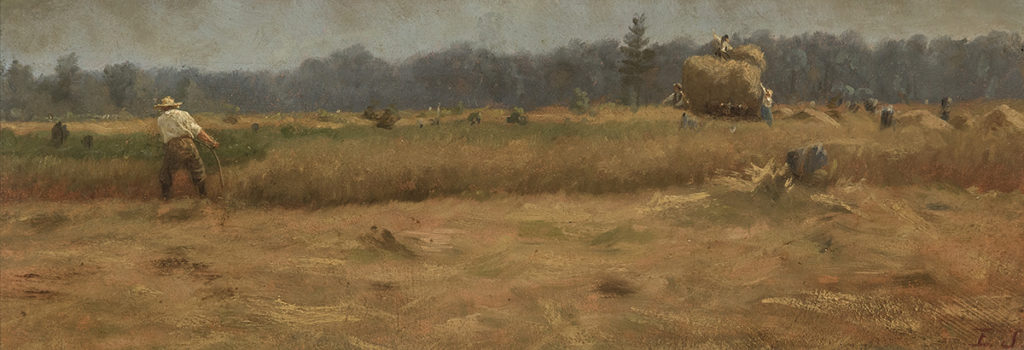
Harvest, 1860s-70s
Eastman Johnson was born into a large family in Lovell, Maine in 1824, but he was raised in Augusta, Maine after he turned ten years old. Many of Johnson’s later works were influenced by the Barbizon School. Although he painted many portraits of prominent individuals, he is best known for his humble genre paintings of rural life, including Negro Life in the South (New York Historical Society), which established Eastman’s reputation. Johnson’s paintings often exhibit an air of optimism, similar to that of his contemporaries, William Sidney Mount and Winslow Homer. Besides his painting ability, Johnson is recognized as one of the founders of the Metropolitan Museum of Art.
In 1840, Johnson’s father sent him to Boston to begin an apprenticeship with a lithographer, but the Maine native returned home to open a crayon portrait studio, which he used throughout the 1840s. He put down his crayons for oils in 1849, and departed for Dusseldorf, where he studied with Emanuel Leutze and Worthington Whittredge, before studying at The Hague and earning the moniker as the American Rembrandt. Johnson was offered a position as Court Painter, but opted to return to America, where he established a portrait studio in New York in 1858. Johnson was one of the few artists of his time to paint African-American subjects, and his 1859 painting, Negro Life in the South, sparked Johnson’s career. Throughout the next two decades, Johnson painted runaway slaves, young women and children, Union troops, and maple-sugaring camps. When genre painting became relatively unpopular in the 1880s, Johnson turned back to portrait painting in his Nantucket Island studio.