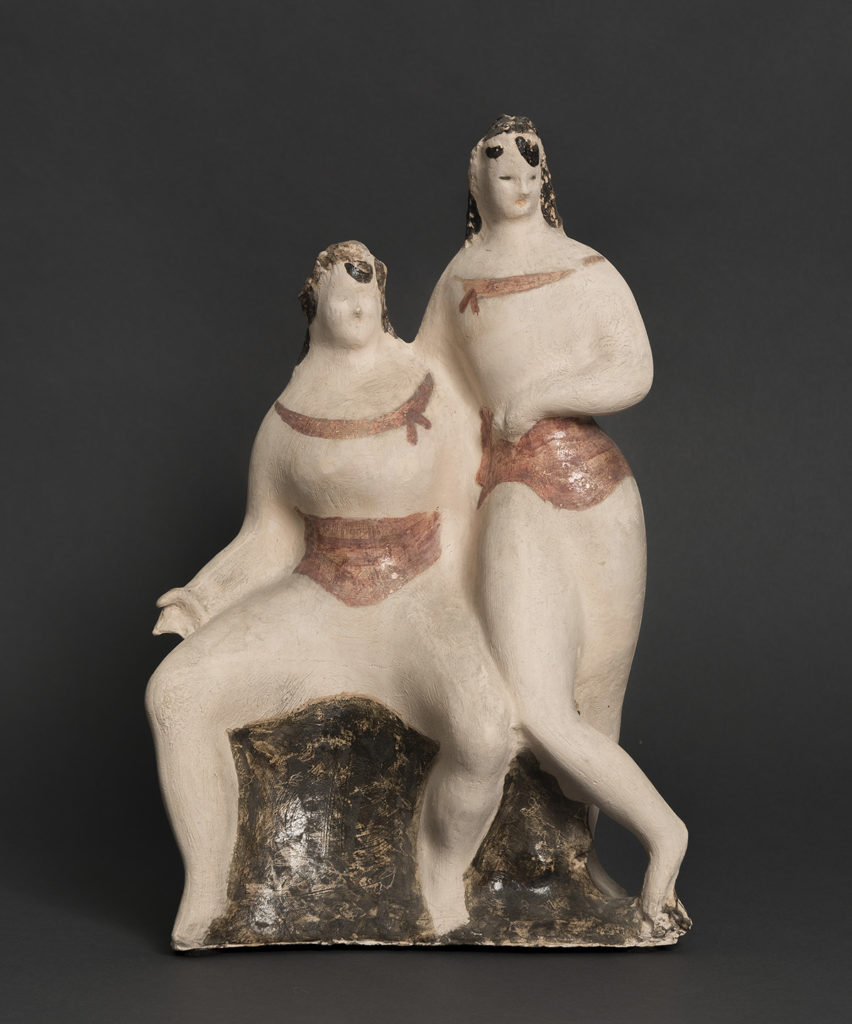
Two Circus Women, c. 1930-35
In the early years of the century, Elie Nadelman made his way to Paris, a hotbed of Polish expat activity, where he dedicated himself to the problems of volume and form in sculpture exclusively. His 1907 plaster Head of a Man, now lost, exhibited an exaggeration of the human form’s geometry, in Nadelman’s words “significant and abstract; i.e. composed of geometrical elements.” (As quoted in Kirstein, The Sculpture of Elie Nadelman, p. 14). The human figure, he wrote, was a “pretext for creating significant form.” (Kirstein, 16). Picasso, still years from his own analytical cubist sculptural heads, took notice, and critics have cited Nadelman’s work as exerting a significant influence on the cubist. Adolphe Basler observed, “The principle of spherical decomposition in the drawings and sculptures of Nadelman preceded in effect, the inventions of the Cubists…He had assimilated the Hellenistic formulae of the second century.” (As quoted in Kirstein, p. 20) In particular, critics have seen in Nadelman’s work the influence of the fourth century BC Greek sculptor, Praxiteles. If Nadelman’s method was revolutionary in Paris in 1909, it was also a rediscovery of the ancients.
Fleeing Europe at the outbreak of World War I, Nadelman lived the rest of his life in New York. He was welcomed by Stieglitz, who had imported drawings in 1910, and later by Alfred Barr, who wooed the sculptor for a retrospective at MoMA. Though intensely private about his own work, he amassed a large and groundbreaking collection of American folk art. The field of American folk art was largely unconsidered at the time, but Nadelman’s own artwork was rejuvenated by contact with the material. Across his shifting career, it was contact with these unadorned forms of human expression, both classic and vernacular, that formed the bedrock of his aesthetic.