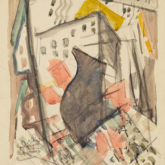
Downtown, New York, c. 1925
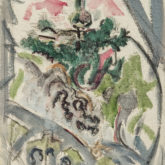
Little Fir Tree, Deer Isle, 1921
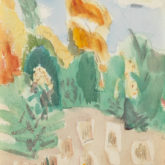
Maine, Deer Isle, c. 1919
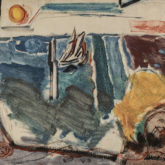
Sailboat, Sea, and Sun, 1921
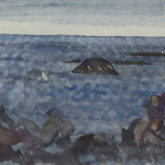
Sea Fantasy, Maine, 1937
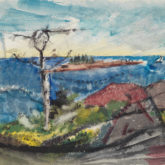
Vicinity of Small Point, Maine, 1931
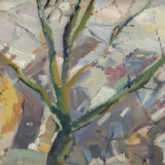
Weehawken Sequence, by 1916
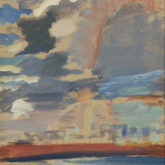
Weehawken Sequence, by 1916
John Marin holds a special position in American art, having begun his art-making under the spell of Whistler and concluding as the godfather of Abstract Expressionism. Born in 1870 in Rutherford, New Jersey, Marin did not commit himself to art as a career until around age thirty. By 1910, his association with Alfred Stieglitz propelled him to a Europe where the seeds of his modernist conversion were planted. Marin, characteristically glib, wrote that he “played some billiards, incidentally knocked out some batches of etchings” [quoted in Baur, 1981]. But certainly the etcher also found time to absorb the proto-Cubist works of Paul Cézanne and Robert Delaunay. The following year, his work progressed rapidly from the hazy washes of a nineteenth-century graphic aesthetic to the semi-abstracted explosions of line, form, and color for which he would soon become famous. By the middle of that decade, he had established a lifestyle as well as an artistic voice that he would explore, to great acclaim, for the rest of his long career. His winters were spent either in New York or in Cliffside, New Jersey, while summers were spent primarily in Maine.
Marin’s work sold well all throughout his time with Stieglitz, even maintaining a strong sales record through the Depression. Around 1909, with Stieglitz’s encouragement, Marin moved with little hesitation into the idiom for which he is most recognized. Working always from landscape, the watercolorist used highly expressive slashes of color to animate scenes with a unique energy. His compositions hint of cubism, and sometimes of naïve expressionism, sometimes of a post-impressionist flavor, but alight finally on none of these. The artist himself was certainly exposed, already by 1910, to all of these influences, but, with his characteristic playful irreverence, he claimed to have little knowledge of any of these painters. (At shows in 1907 and 1908, his work hung alongside Matisse.) [Fine, p. 77] His watercolors in particular possess a vivacity and confidence that is rarely matched. While sometimes considered secondary to oil, it is the very quality of immediacy and inalterability of the medium that showcases his bold stroke. While oil can be scraped off, painted over and reworked a thousand times, watercolor allows and in fact celebrates only the recording of the initial gesture. Marin gloried in that initial gesture, and where De Kooning sank gallons of paint to record his “full arm sweep,” Marin’s watercolors carry all that electricity across inches of paper. He married in 1911, and bought a home in Cliffside in 1920. He wrote often and effervescently to his friend Stieglitz, who would remain his dealer until the latter’s death.
He found his way from etching to watercolor, which would remain his favored medium, and, intermittently, to oil painting. His contribution to watercolor as an artform cannot be overstated. What was previously treated as a sketch or a pastime – even in the hands of highly-esteemed practitioners such as John Singer Sargent – was for Marin a complete work, the most immediate and powerful path to expression. The association between watercolor and softness of both technique and of subject was broken by Marin’s work. Of the some three thousand works he produced, the vast majority—probably around 2,500 – are watercolors. His contributions to painting on canvas are equally if not more important: by 1950, he was among America’s most revered modern painters, just as the world was coming to recognize the New York School as the tremendous force that it came to be. John Marin is likely alone in being a favorite artist of Alfred Stieglitz, Clement Greenburg, and Peggy Guggenheim, and is certainly among the most important painters of the twentieth century. When he died in 1953, still working with undiminished verve, he was probably America’s favorite painter. Marin was among the few American modernists to be recognized for his contributions during his lifetime, achieving commercial success and critical acclaim from 1910 on.
Castorland
1913’s summer was spent in Castorland, New York, where the early autumn or late summer afforded him this view of a plane of vibrant green to offset a single turning tree. Within a few years, Marin would produce his brilliant and prescient Weehawken Sequence of oils, where his abstracting tendencies as well as high-keyed palette on display in the present work would reach a fever pitch.
Weehawken
Scholarship has debated the dating of all the works from the Weehawken sequence: their formal and chromatic sophistication is startling given their early date. The academic community has nonetheless reached consensus that all of the works from this series were executed very early in Marin’s career, between roughly 1910 and 1916. Their full mastery of post-impressionist color and their prescient application of painterly gesture help place them as some of the earliest examples of advanced abstraction in American. Marin would have been first to point out that each work was drawn from life and maintains a tether to the practice of observation, but the daring with which they are executed pushes them far beyond Marin’s contemporaries. Marin, in his lifetime, held the admiration of de Kooning and Pollock, and these works have been called “proto-Guston” [Klaus Kertess, John Marin: The Weehawken Sequence (2001), p 5] and “possibly the first American artist to make abstract paintings” [Roberta Smith, “John Marin: The Weehawken Sequence,” The New York Times, Feb. 17, 2001]. That all of these remarks are true while the works are also so beautiful has befuddled historians for a century: rarely has an innovation this extreme proven so successful.
Marin would have been exposed to the Fauves during his 1905 trip to Paris, and while we do not have a record of a particular thread of influence, the stamp of Andre Derain and Henri Matisse is all over Marin’s early oils in the following decade. The palette shared by the French post-Impressionists is on full display, as is Matisse’s innovative use of incising into thick impasto with the back of the brush. The series is painted with brilliant abandon, yet recognizable imagery remains visible. Indeed, Marin painted outdoors exclusively – the small size of the canvas-panels of the series is a vestige of the plein air practice. Marin would keep to restrained scale even into the nineteen fifties, in part working under shadow of the great success of these early works. His vocabulary of gestures would change over the years, refining a group of riffs and forms into a signature style. But in the early years of the 1910s, Marin tried everything and everything. These germinal laboratories are not only some of the most advance paintings made in America before World War I, they also circumscribe the territory of modernism within which Marin would spend the rest of his life on expedition. Marin himself claimed that some of the Weehawken pictures were done as early as 1903, but this is unlikely.In a few short years, Marin would turn from oil to work primarily in watercolor.
Maine
In 1914, John Marin visited the state of Maine for the first time. He found the terrain vibrant and inspiring, “one fierce, relentless, cruel, beautiful, hellish and all the other ish’s place” [as quoted in Ruth Fine, John Marin (1990), p. 168]. His first summer in the state was spent in the area around Casco Bay, including West Point and Small Point. He would return to the state throughout his life, often to Casco Bay where he found “some enchanted solitude like Prospero’s isle in The Tempest,” according to the critic Henry Tyrell [Op. cit., p. 168]. In 1914, Marin was, as he would remain, one of Alfred Stieglitz’s most commercially successful artists, so much so that he freely advanced Marin money for sales that he was certain would soon materialize. So immediate and profound was Marin’s love of the Casco Bay scenery that he quickly committed to it: Paul Rosenfeld reported that Marin asked Stieglitz for an advance on sales in 1914, saying that “$1200 would be adequate support for him and his wife for the year, departed for Maine only to return six weeks later to announce that he’d bought a very beautiful island with the money Stieglitz had given him, the drawback being that there was no water on it [Op. cit., p. 166] Marin coped with the plumbing-less hardships of his new Marin Island with the cheerful aplomb with which he greeted all adversity:
To go anywhere I have to row, row, row. Pretty soon I expect the well will give out and I’ll then be even obliged to go for water and as I have to make water colors – to Hell with water for cooking, washing, and drinking [Op. cit., p. 168]
Evidently, over the years, the rowing wore on him, his wife, and newborn son, as he gradually explored other mainland locations along the coast. In ensuing summers, Marin decamped for different areas of the state, beginning in 1918 when his favorite house at Small Point was overbooked. He visited Stonington and Deer Island in the 1910s and 20s, his work ranging from relatively literal to highly abstracted. In 1932, he was back in Small Point, where the present work was painted. Although he had abandoned the notion of building on his island, Marin was evidently still lugging water around the mainland, writing Stieglitz in August from Sebasco, Maine:
Old Mistress—Maine—she makes you to—lug—lug—lug—she makes you to—pull—pull—pull—she makes you to—haul—haul—haul—and when she’s thrashed you a aplenty, between those thrashings
she’s lovely
she smiles
she’s beautiful
with an unforgettable loveliness—an unforgettable beauty—Turns masculine—borders big and mighty—against—the big and mighty Atlantic— [The Selected Writings of John Marin (1949), p. 144]
In 1934, Marin added Cape Split, Addison, to his Maine stomping grounds, making the family home there until his death in 1953. He wrote of his seaside home:
If you grab the place up and give her a haircut — wash her face — hang her upon the line to dry — and such things as should be done for her I’ll be — ever and plenty — obliged so here’s to you — your dearly beloved — the Spirit of the Cape [as quoted by Ruth Fine in John Marin (1990), p. 230].
In these heroic terms, Marin captured his Maine, and the present work is an excellent example, the “big and mighty Atlantic” bracing against “his furious brother” the beach, boulder, and timber of the forest. He continued, to Stieglitz:
Such – to sit and behold—is the – painter man’s dream…Ah now – what a swell—picture [Op. cit., p. 145]
In 1919, Marin summered for the first time in the Stonington-Deer Isle area, remarking that
this place of mine, a village, where clustered about you can see if you look dream houses of purity of whiteness, of a loveliness of proportion, of a sparingness of sensitive detail, rising out of the greenest grass sward [as quoted in Ruth Fine, John Marin (1990), p. 180].
In 1927 Marin executed a series of about twenty-three watercolors at Deer Island, all meditating upon boats and the sea. He playfully titled this expansive series, “The Sea and Pertaining thereto.”
New Mexico
Marin spent only two seasons in Taos, New Mexico, staying on land owned by Mabel Dodge Luhan in 1929 and 1930, but the time he spent there was tremendously important. [Fine, p. 217] The landscape itself played to his sensitivities to geometric abstraction. The vastness of the prairie and the looming mountains clearly attracted and challenged him in much the same way as the Maine landscape and sea had. [Norman, p. 128] A critic glowingly reported that “[The New Mexico watercolors] range in mood and manner from the tenderly lyric to the overwhelmingly torrential. Marin says they are the last watercolors he is going to do.” [As quoted in Fine, p. 225] Of course this turned out not to be the case – Marin continued to produce watercolors, in volume, for the rest of his life. Perhaps the critic was mistaken, but it is just as plausible that the painter believed in 1930 that he had in New Mexico made his final statement in the medium.
New York
John Marin’s highly expressionist watercolors of New York are among the most iconic images of the city, as well as being important contributions to American modernism. Beginning in the early 1910s, Marin investigated the growing city in radically animated lines of brilliant color. Among the most revered of these are his renderings of the Brooklyn Bridge looking toward Manhattan past reddening skies.
In his own words, to accompany an early exhibition of his works of city subjects, Marin elaborated on the appeal of New York and the exhilaration he felt working to capture the energy and drama of the cityscape [“Water-Colors by John Marin,” Camera Work, nos. 42-43, April-July,1913, p. 18]:
Shall we consider the life of a great city as confined simply to the people and animals on its streets and in its buildings? Are the buildings themselves dead? We have been told somewhere that a work of art is a thing alive. You cannot create a work of art unless the things you behold respond to something within you. Therefore, if these buildings move me, they too must have life. Thus the whole city is alive; buildings, people, all are alive; and the more they move me the more I feel them to be alive.
It is this ‘moving of me’ that I try to express, so that I may recall the spell I have been under and behold the expression of the different emotions that have been called into being. How am I to express what I feel that its expression will bring me back under the spells? Shall I copy facts photographically?
I see great forces at work: great movements; the large buildings and the small buildings; the warring of the great and the small; influences of one mass on another greater or smaller mass. Feelings are aroused which give me the desire to express the reaction of these ‘pull forces,’ those influences which play with one another; great masses pulling smaller masses, each subject in some degree to the other’s power. . . . While these powers are at work pushing, pulling, sideways, downwards, upwards, I can hear the sound of their strife and there is great music being played. And so I try to express graphically what a great city is doing. Within the frames there must be a balance, a controlling of these warring, pushing, pulling forces.
When the space provided by a painting’s stretcher seemed somehow unable to confine Marin’s energetic brushstrokes, the artist chose not to frame his works again with George Of, the New York framemaker that Stieglitz favored. Rather, Marin determined to make his own “painted frame,” in this case a wooden frame that is rendered with bands of white and red pigment, mirroring the colors of the lights and clouds in the composition. Hilton Kramer offered the following analysis in his essay that accompanied the 2000 exhibition John Marin: The Painted Frame at Richard York Gallery, New York [p. 12]:
…from the outset of his effort to encompass this “frenzied dance” of modernity in a painting that would be clearly seen to be modernist in its structure, Marin seems to have understood that it required for its completion the setting of boundaries – that the release of so much painterly energy called for a countervailing pictorial framework to support and sustain its exuberance. And it was for this purpose that he developed one of his most inspired pictorial inventions – the painted frame, which would have the dual function of containing the “clamour of detonations” while serving as something like a coda to the sheer musicality of his principal motifs.
At mid-twentieth century, John Marin was widely acknowledged to be the most important living painter in America. He was credited for his innovative and daring work in watercolor, but at this time was devoting a considerable amount of his ample creative energy to painting works in oil. From the beginning of his career, most notably in his early “Weehawken Sequence,” Marin had chosen to work in series, weaving the next watercolor or oil to the stylistic themes he had developed, in order to consider similar subjects in different moods and palettes.
Public Collections
Ackland Art Museum, University of North Carolina at Chapel HillAlbuquerque Museum
Allen Memorial Art Museum, Oberlin College
Amarillo Museum of Art
Amon Carter Museum
Arizona State University Art Museum
The Arkansas Arts Center
The Art Institute of Chicago
The Baltimore Museum of Art
Blanton Museum of Art, University of Texas, Austin
The Brooklyn Museum
Butler Institute of American Art
Cantor Arts Center, Stanford University
The Cleveland Museum of Art
Colby College Museum of Art
Colorado Springs Fine Arts Center
The Columbus Museum of Art, Ohio
The Columbus Museum, Georgia
Corcoran Gallery of Art
Delaware Art Museum
Denver Art Museum
Eiteljorg Museum of American Indians and Western Art Museum
Everson Museum Of Art
Farnsworth Art Museum
The Fred Jones Jr. Museum of Art, University of Oklahoma
Frederick R. Weisman Art Museum
The Harwood Museum of Art, University of New Mexico
Harvard Art Museums
Herbert F. Johnson Museum of Art, Cornell University
High Museum of Art
Hirshhorn Museum and Sculpture Garden, Smithsonian Institution
Hunter Museum of American Art Indianapolis Museum of Art
The John and Mable Ringling Museum of Art
Jonson Gallery of University of New Mexico
Kresge Art Museum, Michigan State University
Lauren Rogers Museum of Art
Los Angeles County Museum of Art
Maier Museum of Art, Randolph-Macon Woman’s College
McNay Art Museum
Mead Art Museum, Amherst College
Memorial Art Gallery, University of Rochester
The Metropolitan Museum of Art
Montgomery Museum of Fine Arts
Munson-Williams-Proctor Arts Institute
Musées Nationaux, Paris
Museum of Art at Brigham Young University
Museum of Fine Arts, Boston
The Museum of Modern Art, New York
Museum of New Mexico
National Gallery of Art
National Portrait Gallery, Smithsonian Institution
The Nelson-Atkins Museum of Art
Neuberger Museum of Art, SUNY, Purchase College
New Jersey State Museum
The Newark Museum
Norton Museum of Art
The Old Jail Art Center, Texas
Ogunquit Museum of American Art
Oklahoma City Museum of Art
Pennsylvania Academy of the Fine Arts
Pensacola Museum Of Art
Philadelphia Museum of Art
The Phillips Collection
Phoenix Art Museum
Portland Art Museum
Portland Museum of Art
Reynolda House Museum of American Art
Rhode Island School of Design Museum of Art
Robert Hull Fleming Museum, University of Vermont
Rose Art Museum at Brandeis University
Roswell Museum and Art Center
San Diego Museum of Art
Santa Barbara Museum of Art
Seattle Art Museum
Sheldon Museum of Art
Smith College Museum of Art
Smithsonian American Art Museum
Snite Museum of Art, University of Notre Dame
Southern Alleghenies Museum of Art, Saint Francis College Mall
The Speed Art Museum
Springfield Museums, Massachusetts
The Toledo Museum of Art
University of Kentucky Art Museum
The University of Michigan Museum of Art
Wadsworth Atheneum Museum of Art
The White House
Whitney Museum of American Art
Williams College Museum of Art