
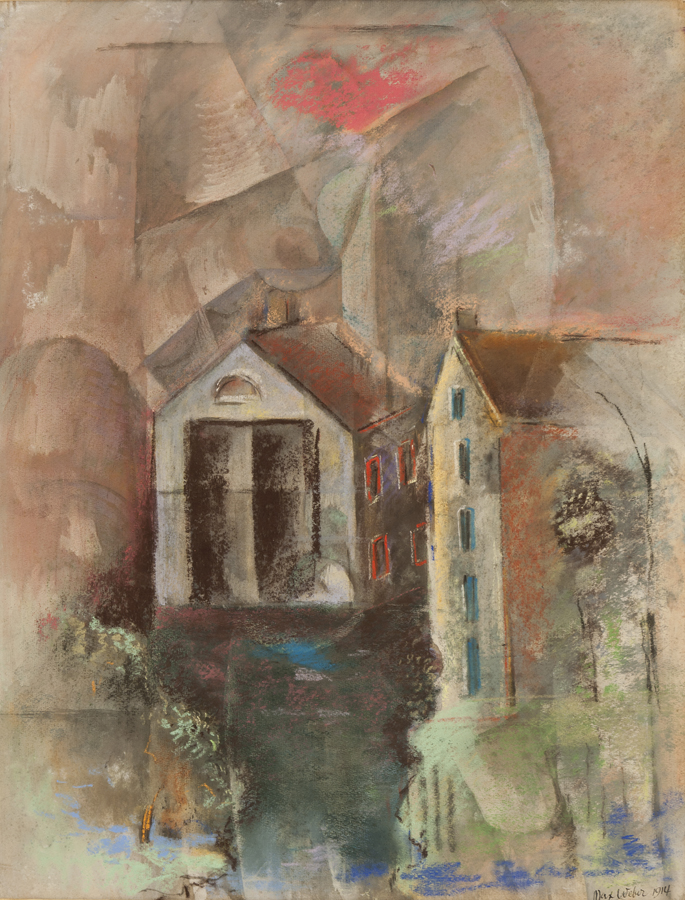
The Village, 1914
Max Weber was a pioneer of Modernism in American Art. He went through many incarnations as an artist, with works that are rooted in various movements including Fauvism, Cubism, Dynamism, Expressionism and Futurism. Today one of his most celebrated works, Chinese Restaurant, 1915, from his Cubist phase, hangs in the Whitney Museum of American Art in New York.
Born on April 18, 1881 in Białystok, Russia, Weber moved to The United States a decade later. He enrolled at the Pratt Institute in 1898, taking lessons from Arthur Wesley Dow until 1900. He then spent three years teaching at a public school in Lynchburg, Virginia until he saved enough money to get himself to Europe, where he enrolled at the Académie Julian. While there he worked in the atelier of Jean-Paul Laurens, but finding it too constricting he left. In 1906 he had work accepted into the Salon d’Automne where he was exposed to fellow artist Paul Cézanne who became a huge artistic influence on Weber. He also met Henri Rousseau who became a lifelong friend. In 1908 Weber entered Henri Matisse’s class, and his works began to display elements of Fauvism. In 1909 Weber returned to New York, and a year later he organized the first solo show for friend, Henri Rousseau. This same year he was included in Alfred Stieglitz’s “Young American Painters” show. In 1911 Stieglitz gave Weber his first solo show at his New York “291” gallery. Being the chameleon of Modernism that Weber was, he went through many artistic phases, though all of which were rooted in the avant-garde. In 1915 he produced his most well known work, Chinese Restaurant which displays strong elements of Cubism, heavily influenced by Picasso. In the 1920s he focused on creating a series of nudes, for example Bathers and Sails, 1928 (Smithsonian American Art Museum, D.C.), and in the 30s he created several social realist paintings. In 1930 New York’s Museum of Modern Art put on a mid-career retrospective of Weber’s work. Max Weber died in Great Neck, New York in 1961. Today, his works are represented in over thirty museum collections nationwide.