
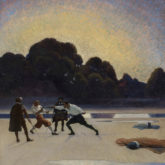
The Duel on the Beach, 1920
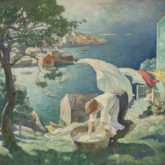
Wash Day on the Maine Coast (Harbor, Monday Morning; Monday Morning on the Maine Coast), 1934
Newell Convers Wyeth was born in 1882 in Needham, Massachusetts. His father, Andrew Newell Wyeth, descended from a long line of Wyeths in America, beginning with Nicholas Wyeth, who arrived from England and settled in the Boston area in the mid-seventeenth century. A stonemason by trade, Nicholas bought a home in Cambridge, and his progeny were the stuff of American history and Massachusetts mythology: Jonas Wyeth disguised himself as a Native American to take part in the Boston Tea Party; Ebenezer Wyeth fought the British at Bunker Hill; John Wyeth assumed the office of postmaster of Harrisburg, Pennsylvania, for his support of George Washington, and Nathaniel Jarvis Wyeth sought adventure on the Oregon trail. On his mother’s side, N. C. knew the family history back to Bern, Switzerland, just two generations past. The Zirngiebels arrived in Cambridge in 1856, and when the families were co-mingled with the marriage of Andrew Newell Wyeth and “Hattie” Henriette on December 21, 1881, their assimilation into America was complete. Thus was secured for N. C. that most American of heritages: one side recently immigrated from the old country, the other with centuries of history in the New World. Together, the family history provided all the source material for imagination that a boy, and then an artist, could ever hope for: western explorers; Europeans on the high seas; conspirators and rebels, founding fathers and postmen: these characters would people the dreams and the paintings of Newell Convers for the rest of his life.
Biographer David Michaelis described N.C.’s mother, Hattie, as having “difficulty separating herself or her feelings from people and things she cared about.”
She saw everything as an extension of herself and attributed emotional awareness even to inanimate objects. She felt sorry for burnt cookies, and favored them over the better ones in the batch. When the family decorated its Christmas tree, she “felt sorry for the back of the tree and always hung lots of ornaments on rear branches” [Biographer Michaelis, N.C. Wyeth: A Biography (1998), pp. 17-18].
Hattie’s husband, by contrast, was punctual, austere, and reserved. These temperaments fueled N.C.’s iconography: heroes were often stolid and reserved, while inanimate objects were elevated with magical emotional life. Apart from scenes of pure fantasy, the emotional lives of objects are also on view in the many commercial illustrations N.C. executed. Everything was dramatic in N.C.’s world, beginning in childhood – there was no such thing as the inanimate.
As for actual source material, it was life’s adventure, not literature. Family lore held a connection to the naturalist Louis Agassiz, and certainly the young Wyeth held to Agassiz’s dictum to “Study nature, not books” [Ibid., p. 25]. “I’m not a fellow of much knowledge,” he would later observe, “but what I have was born in me as I’m sure I didn’t acquire much from school.” His stern Swiss-American mother was a firm taskmaster and the young Wyeth was, despite his obdurate nature, a perfect attendant to Needham High School, which he attended from 1895-97. Notably, the young fantasist did not live his imaginative life through story-books. His biographer noted that Robert Louis Stevenson and James Fenimore Cooper, the boys’ adventure primers of the day, were unknown to the young N.C., who spent his playtime rehearsing battles with his playmates. The only exception, perhaps owing to his mother’s heritage from Bern, was The Swiss Family Robinson, written by Johann David Wyss, of the same Swiss town as the Zirngiebels. It was hearty adventure stuff, frontier life in an exotic locale, but it must have also had profound meaning for the Swiss side of the family, who might have seen Needham, Massachusetts, as their own desert island far from home. In any event, the young N.C. was on his own personal island when, in 1897, he declared his intentions to be pursue a career as an artist. His father insisted he choose a vocation more useful than “shiftless, almost criminal” artist, and suggested that manual farm labor in Vermont might disabuse his son of “this artist nonsense out of his head” [Ibid., p. 33]. Hattie took sides with her son in the dispute, and the eventual compromise was that he attend the Mechanic Arts High School in Boston. The trade school taught draftsmanship for mechanical engineering, and thus might prepare N.C. to be an architect or engineer.
This juncture was remembered as “one of the most memorable crises of our household” [p. 33], and it played a formative role in N.C.’s working life. From that point forward, N.C. had a clear line in his own mind between the crafts of an illustrator and those of a fine artist. While he would at times struggle to bridge them or to move from one to the other, he never failed to understand the difference, even as the line blurred in his own time and after. His career happened to overlap perfectly with a period of immense change in American art. When he was born in 1882, the Hudson River School painters were only recently seeing their style scorned. Bierstadt painted his swan song, Last of the Buffalo, in 1888, and Frederic Church spent the last two decades of the century and his life working on his dream-house, hobbled by arthritis and critical indifference. Impressionism had leaked into vogue via mainly Boston-area painters who studied in France, and Winslow Homer was at the height of his career as a watercolorist oil painter in N.C. Wyeth’s young childhood. By the time he was beginning his career, a generation of artists was rising from Philadelphia newspaper illustration, growing into what would become the Ashcan School. All of these were trends within what could broadly be understood as a “realist” tradition—but the flavor of realism was profoundly in flux. Whose reality, and how realized? Artist at the turn of the century from all corners had a potential claim on the territory.
Visions of the American landscape turned from idealizations of the wild to nostalgic visions of the recently-closed frontier. The traditional genre scene was supplanted by fashionable urban and pastoral views rendered in Impressionist modes by Childe Hassam, Theodore Robinson, Winslow Homer, and soon these, too, would be supplanted by the gritty urban realism of The Eight. And with the 1913 Armory Show, the fine art world in America was again rocked, this time with the advent of Modernism. Wyeth’s career encompassed all of these seismic shifts, and his compass through the tumult was a workmanlike understanding of the craft of picture-making, as the drama of life was served by the drama of light, and vice versa. Story-telling was baked into his picture-making from the beginning.
Young N.C. felt that he was behind in his own development in terms of artistic training, but he soon found himself catching up. His sense of his own deficits was met with a need for toil, and this work ethic lit up when he heard, through fellow student Clifford Ashley, of the Howard Pyle School in Chadds Ford, Pennsylvania. To Wyeth’s ears, the Pyle school had the quality of a monastic guild: twelve Pyle disciples labored as the master’s students, studying fundamentals in uninterrupted industry. Those who sought to join the free-tuition school would first prove their worthiness by dorming in nearby Wilmington, Delaware, and working in Pyle’s midst, subjecting themselves to his judgment. The austerity and seriousness of the challenge absorbed Wyeth, and he arrived in Wilmington in 1902. “It was all magic to me, and tremendously romantic,” he recalled of Chadds Ford [p. 52]. Howard Pyle was the king of illustration in its golden age, and publishers sought his work as well as that of his students. Pyle accepted Wyeth into his outer circle instantly, and while Wyeth struggled to join the master’s inner circle, he also executed his first finished illustration work. For these, he followed Remington as a direct model, writing to his mother to send copies of the western painter’s illustrations from Century magazine, “I really need them. As I pose as an artist of western pictures I’ve got to have Remington’s drawings in for reference of costume, etc.” [p. 62]. The work he produced was directly out of Remington central casting, in more ways than one: it could have been a drawing almost directly from Remington’s most famous bronze, The Bronco Buster. Novelty was prized below excellence in the editorial offices of the Saturday Evening Post, however, and when the Feb. 21, 1903 issue hit the stands, it bore the same name as Remington’s sculpture. Derivative though it may have been, it was a major coup: this was arrival at the only destination that mattered for a young illustrator. Pyle soon accepted Wyeth into his inner circle, but the price of admission was total dedication. Wyeth was eager for the punishing rigor, but he also labored under the emotional debt to his parents to be financially productive—and Pyle demanded that his students do no commercial work while studying with him.
Pyle was by all accounts a difficult taskmaster, prone to flights of fancy and unannounced rage. He dismissed students at whim, picked their work apart while praising it as “genius,” and generally ran a Paris Island-style boot-camp, inspiring a profound loyalty and gratitude. In short, it was exactly what Wyeth sought. And, for all his prohibitions, Wyeth found time under Pyle to sell his first book covers and other illustrations (I Could See Only His Shaggy Head, 1903), The Moose Call, 1904), and to court Carol Bockius, “the prettiest girl Wilmington” [Ibid., p. 87]. By the following August, Pyle announced that Wyeth had learned all he could teach him.
Newly “graduated,” Wyeth’s career progressed rapidly – as it indeed had been under way for several years already. By 1906, S.S. McClure told Pyle that N.C. Wyeth was “the only man in the United States that can do the work McClure’s Magazine wants” [p. 145]. Wyeth remarked: “That sounds preposterous, don’t it?” [Ibid.], but the truth was that his natural talents had been augmented by hard work and Pyle’s unimpeachable stamp of approval: Wyeth could work anywhere he wanted. That year, he and Carol Bockius were married, and soon Carol was pregnant.
Everything was taking shape rapidly, but Wyeth was nonetheless struggling to emerge from the many strong paternal shadows that fell across him. Their first child died in infancy in 1906. The same year, roiling in grief, Wyeth struggled to produce fine art canvases, but was rebuffed by the Pennsylvania Academy of the Fine Arts. The young painter’s work was gracing the covers of magazines with circulation reaching millions, but he remained, in his own estimation, incomplete. In 1908, the New York Herald reported on his profound commercial success, but Wyeth said he was “more ashamed than ever to be ranked as [an illustrator]” [Ibid., p. 170].
Howard Pyle’s teaching is a terrible blight to all who studied with him. He is responsible for spoiling the possible opportunities of a number of fellows—and as for me, I know his short-cut training has brought me a success that has been wholly misleading and which has placed me in a position from which it is questionable that I will ever be able to disentangle myself [p. 170].
With these grim words, Wyeth began what was ultimately a life-long struggle to gain independence—from Pyle, from the indebtedness to his toil instilled by his parents, and from the opprobrium of illustration. When this break in temperament came, it was sudden and strong. But Wyeth was always pragmatic, and he would not ever abandon illustration and did not do so even in this moment of passion. He divided his day into hours spent for illustration work and hours for proper plein air painting. He shifted his attitude toward illustration to elevate it from mere hack-work to something loftier, turning down “rush orders” with disdain: “Can a poet write real verse with an idea in his mind where it is to appear and how it will impress people, or will the editors like it? No, a thousand times, no!” [Ibid., 175]. By 1910 he was winning prizes and sales at the Pennsylvania Academy of the Fine Arts, “But this does not mean much to me! How eager I am to paint paint paint!” [Ibid., 176]. A man always bent on toil, he was now driven, and “paint paint paint” could have been his mantra in these years. He turned down offers to exhibit at traditional fine art galleries like Macbeth in New York and Marshall Field in Chicago, feeling his work to date still too embryonic to represent him. “Wait, you people, wait until I do something good!”
Even as his illustration work was graced with new poetry and immense commercial success and his easel painting grew in artistic maturity, he grappled with the legacy of Pyle and his parents. The stamp of his father’s disapproval and his mother’s stern judgment remained. As he wriggled with contempt for the crass picture-factory of Pyle, he could not shake the notion that fine art was for snake-oil salesmen, lazy and disingenuous. He paid for this bedrock belief by working hard at both, punishing himself for indulging in either art or craft as if both were equally black expressions of his rotten character.
He set a plan to wean himself from illustration, developing a multi-year plan on which he might live at reduced income so that he could work solely on fine art. Another child came, and soon he quarreled with his father again over money and life’s direction. Circumstance seemed to rear up from every angle to keep Wyeth in the illustration game, and the decisive blow was dealt by success. Scribner’s hired him to produce an “elaborate edition” of Treasure Island, Robert Louis Stevenson’s children’s book about life on a pirate island. In 1911, he took the job and with its cash advance and a mortgage, he bought the land that would become the family estate at Chadds Ford. “I’m totally satisfied,” he remarked, “that this is the little corner of the world wherein I shall work out my destiny” [Ibid., p. 195].
He did. Treasure Island became a huge success, followed by many others. Newell Convers Wyeth, Jr., was born. Howard Pyle died later that same year, and Wyeth released himself almost instantly from the resentment that had gripped him for years. “Do you ever realize what unutterable tragedy it is to be always living in the past or anticipating the future?” he wrote to his mother in 1913. For a brief moment he seemed to be doing neither: the demons of the past were briefly at bay. The work came with ease, albeit with the usual sweat and tears that accompanied all of Wyeth’s work.
This period saw the production of Wyeth’s best work, and his change of attitude was permanent though not total. Depression and sadness would return in coming decades, not least when, in 1925, his mother died after prolonged illness. When the Depression hit, it seemed to give the thriving Wyeth family less pause than the painter’s own self-flagellation. His children recall him as “withdrawn” and “deeply troubled” in these years, painting to the point of “burn-out” and yet unwilling “to risk bothering anybody with depressed feelings” [p. 321-322]. His son Andrew was enjoying a critical reception of his own watercolors in 1937, and while he was proud of his son’s work, he cast only a morbid eye upon the shadow of time’s passage across his own work. With Christina’s World, Andrew Wyeth became what N.C. had always wanted: to be considered a great fine artist. Late in his father’s life, Andrew recalled a late-night talk consoling his father that he had achieved something extraordinary: a ubiquity and an immortality through his illustrations that no modern artist could hope to achieve. That immortality was achieved in his own lifetime, and he lived also to see his children succeed; and now, a third generation was just arriving.
Andrew reported that his father was not consoled by these observations. He was a passionate romantic who tamed his soaring feelings of love and despair with arduous labor. This shackled some of his extremes and satisfied others, but ultimately his demons were never allayed for long. His paintings came to be known in association with his more famous son, Andrew, and his illustration fell to the shadow of his teacher, Howard Pyle. Neither teacher nor son could have enjoyed the immortality they each found without N.C.’s efforts, and in certain lights he out-shined them both, as Andrew observed. It was perhaps an indissoluble pebble in the N.C.’s character that he would be frustrated no matter what heights he ascended. In 1945, while driving with his young grandson and namesake, N.C. Wyeth’s car stalled on train tracks near the family home in Chadds Ford. The artist and his grandson were instantly killed.
Despite the tragic end, Andrew’s words about his father’s immortality were born true by time. Few American painters of his generation are remembered as well as N.C. is, and now, along with the lasting impact of his illustrations, his work is hanging in museums. His work is celebrated for its brilliant execution and poetic grace—toil and inspiration married in masterful union.
Selected Historical Exhibitions
Public Collections
American Illustrators GalleryAmon Carter Museum
Baylor School
Brooklyn Museum
Brownsville Museum of Fine Art
Buffalo Bill Historical Center
The New York Public Library
Chazen Museum of Art, University of Wisconsin
The Hill School
University of Arizona Museum of Art
Delaware Art Museum
Diamond M Fine Art Collection Museum of Texas Tech University
Farnsworth Art Museum
Gilcrease Museum
Hunter Museum of American Art
Indianapolis Museum of Art
Joslyn Art Museum
Marietta/Cobb Museum of Art
Metropolitan Museum of Art
Museum of Texas Tech University
Museum of the American West collection
National Cowboy & Western Heritage Museum
National Museum of Illustration
National Museum of Wildlife Art
Needham Free Public Library
New Britain Museum of American Art, Harriet Russell Stanley Fund
Panhandle-Plains Historical Museum
University of Delaware
Rockwell Museum of Western Art
Stark Museum of Art
The First Parish Church, Weston Massachusetts
The Free Library of Philadelphia, Rare Book Department
The Kelly Collection of American Illustration
The Museum of Fine Arts, Houston
The Sordoni Collection of American Illustration and Comic Art, Wilkes University
U.S. Navy Art Collection
Virginia Military Institute Museum