
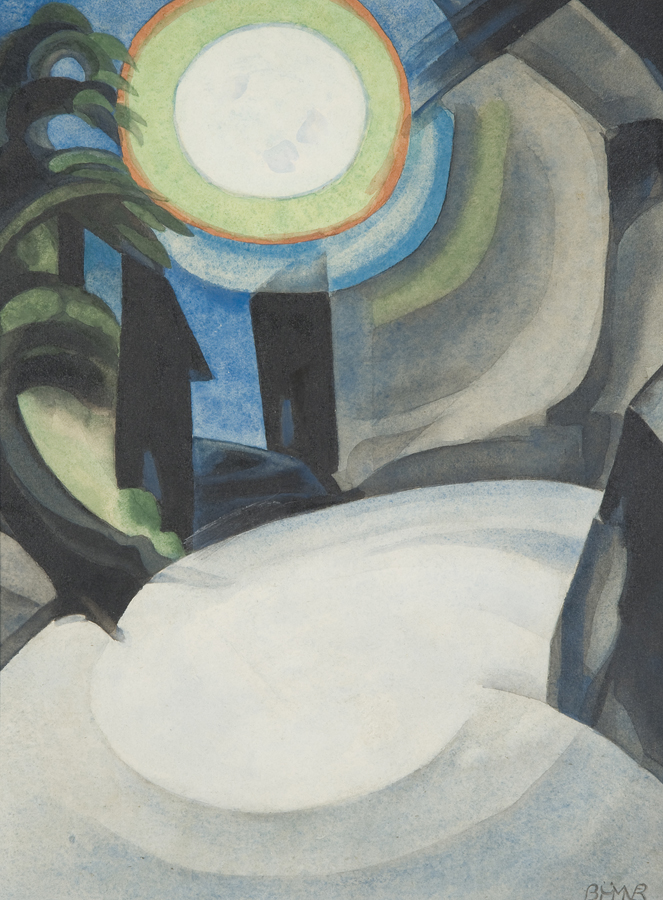
The Color of the Moon: Lunar Painting in American Art, at the Hudson River Museum, Yonkers. The earliest work is from the 1820s—not because that’s the earliest sighting of the moon, but because that’s about as early as American art appreciably goes. On the other end of the timeline, the show ends in 1969: the momentous year of the first moon landing. For millennia, humans had gazed upon the celestial body; pondered; celebrated; trembled with fear and with delight. But it remained that: a celestial body. Is it a god? Near us or incalculably far? Made of cheese, or cold hard stone? The Hudson River Museum rounds up a stunning revue of visual responses, testament to the most democratic thrill of all: looking up to the sky on a moonlit night and being filled with wonder, the world around you remade in bluish midnight glow.
But before 1969, that thrill of contact was strictly visual. It’s one thing to behold, another thing to hold in the hand. That’s a good stopping point for the show, and you can make the case, implicit in that limit, that in 1969, everything changed. One of our species had set foot on the thing—a giant leap for mankind. The facts in the universe had changed forever: now there is an American flag flapping in the breezeless night above us, planted in lunar soil. Something of an art, something of a sport: some things you compete for, some things you do just to see if you can. Some things you do to show that you can. Competition, advancement of understanding, novelty, demonstration: these are the reasons we make art, too.
Of course, some disagree. With all of it—not just the nature of art, but the whole enterprise, the facts of the matter. That American flag on the moon? Why does it seem to flap in the breeze—when everyone knows there is no breeze on the moon? American rockets were surely advanced, but were they advanced enough to actually put someone on the moon? More important: were they more advanced than America’s true greatest strength: the propaganda engine of Hollywood? Surely the most efficient way to convince the world that Americans are on the moon is to just make a movie about it—not to actually do it, right?
It is a rustic comfort to observe today that fake news—even conspiracy theories about fake news—isn’t new at all, and the theory that the moon landing was staged on a back-lot in Anaheim holds just that folksy allure. My favorite theory holds that Stanley Kubrick filmed the fake landing, and then tried to reveal his ruse to the world in clues buried in his 1980 film The Shining. Truly a conspiracy theory at its baroque zenith.
But if there’s a sympathetic underlying attraction to the urban legend, it’s this: the delirious joy of moving from beholding to holding is an unreportable change: Neil Armstrong walked on the moon, but I still just look at it. The important thing is not that the moon got walked on but that the man did the walking. An experiential change took place, but only if you are that particular man; or, maybe, if you identify with that man. (Some don’t: you can imagine that other nations, folks of different political persuasions, might feel a different tingle to know it is an American flag dangling in the airless night above them. Or one giant leap for a man, but woman is still down here staring up at the moon through a glass ceiling.) For the rest of us, it can inspire our imaginations – a man has walked on the moon!!! – but that statement inspires the imagination whether it is true or false.
What I share with the conspiracy theorists and discontents broadly is that contact is marvelous, but it needs to be yours. When a man set foot on the earth’s nearest neighbor, that contact could not be reproduced, demonstrated, proven, to anyone else, no matter how good Stanley Kubrick was. Contact is irreproducible.
Part of the reason Kubrick was thumbed as the agent of the faked moon landing was that Kubrick was working like a maniac on his sci-fi epic, 2001: A Space Odyssey. As much as anything, this movie, too, is about contact. In the famous opening sequence, with Thus Spake Zarathustra blaring, a tribe of apes encounters an enormous black stone. They tremble and cavort; they touch it, retreat from it, and are drawn to it again. In the moments that follow, the leader of the tribe of apes – the script calls this character “Moonwatcher”—makes two odd leaps. First, he discovers tool use – this bit of discarded skeleton is now a weapon! Then, as the music swells, he seems to discover abstract thought, crushing skulls as Kubrick match-cuts between living and dead animals to show Moonwatcher’s imagination at work. Shortly thereafter, the match-cut is deployed again, as the flying bone becomes a soaring satellite, and the audience is ushered into the future.
As with all matters Kubrickian, there are a lot of theories about what takes place in this dialogue-free twenty-minute sequence. The best accepted are: that a super-advanced alien race placed the monolith on earth, and the monolith itself taught the apes how to use tools; or, that a super-advanced alien race recognized that the apes were about to discover how to use tools, and, satisfied that they were ready for a quantum intellectual leap, presented them with the monolith as a welcome-basket to the universe of abstract thinkers.
Personally, I favor a third theory, even more esoteric: apes encounter this enormous slab of perfect craftsmanship: obsidian and relentlessly matte; it soaks up sunlight. Its edges are straight and cut with a form that God never chooses, an arbitrariness of aspect that is both more capricious and more rule-based than anything found in nature. Like an Ad Reinhart canvas, its inky blackness gives way to subtly blacker blacks. The size of a wall, it is nonetheless not a wall; it offers no shelter, no shade; it bears nothing, and does nothing; it seems to be implicitly decorative just by its design. Decorative, and yet profound, portentous. It is 1 foot deep by 4 feet wide by 9 feet tall: the square of the first three cardinal numbers. In short, it is an awful lot like the paintings that a sophisticated art-lover might find in galleries in 1969.
What can it mean? I don’t think that the monolith is a machine that somehow radiates energy and teaches the chimps how to use tools. I think that engaging with this object of extraordinary craftsmanship – in a word, art – inspires the proto-humans, just by virtue of its elegant design. It’s a sort of futuristic technology, but a passive sort of social technology that requires you to put psychic energy in before you get anything out.
Remember the first time you stood before a really great Rothko? What was in it, apart from canvas and pigment? It’s an object of such technical simplicity that we don’t think of it as advanced information technology, but that’s just what it is: the product of years of careful, painstaking thinking, parceled out in laborious craftsmanship, to convey something just beyond the artist’s grasp. That something calls to me, also just beyond my grasp: something calls to you from just beyond yourself. You can’t put it into words; that is a technology either too clumsy or too inelegant to aid you in this terrain. You feel inspired, but shrink in humility even from that word; “inspiration” is a quality you reserve for the magician who made this.
That’s how I interpret that moment. The apes have an encounter with a great artwork. It changes them.
It’s about contact.
It is the fiftieth anniversary of 2001: A Space Odyssey and the Apollo missions to the moon. The impressions of fifty years prior to those extraordinary leaps are recorded at the Hudson River Museum, among others, in the elegiac paintings of the moon by Oscar Bluemner. “Art and Space are a creative duality,” he wrote, in a century ago [Oscar Bluemner, “In other Words,” Bourgeois Galleries exhibition catalogue, 1918]. “Knowledge is a flat thing, as canvas. Feeling is Depth, like Space. Painting is a problem of Deep-Flat.” As he produced modernist masterpieces devoted to the glowing orb of the moon, he reflected upon the importance of immediacy of contact:
“‘Unless you feel it, you will never grasp it.’ In selfless contemplation only we learn to see – with our eyes shut. The humble life-drama of a flower evolves in form and color no less significantly than that of mountain, sea, or star. Creation is projection into space” [Ibid.].
In addition to the orbs that possessed him for a few years, Bluemner, too, composed an epic narrative of the Dawn of Man (“Once long ago before the cave age . . .” begins What and When Is Painting? Today, 1929), but his summary notes on his own sketches are more telling. He made endlessly annotated sketches, carving off forms and then remarking on colors, producing a paint-by-numbers process that generated his final canvases. But this was a mediation, again, of the deep and the flat: you might use up all of your words and still come no closer to expressing the majestic simplicity of the color red. Write all you like – and Bluemner wrote a lot – but contact needed to be made with the work of art itself, visually.
In the end, Bluemner knew as much about the moon as Neil Armstrong or Stanley Kubrick. This is the ultimate lesson of painting in the twentieth century: there is an endless deep-flat problem, an anxiety that life itself might be replaced with a facsimile – be faked, plasticized, or reenacted.
The movie 2001 ends with a wordless series of scenes in which the astronaut, Dave Bowman, encounters himself, again and again, growing older each time. He sees himself from his space pod, standing alone in a Victorian room. His older seems to hear his younger self stir; he looks back to see, but – there’s no one there. He peers into the next room to see another future self, now older still, dining at a table. The diner feels a presence, and looks back, over his shoulder – again, he is alone. He drops a fork; he stoops to pick it up, and catches a glimpse of himself, finally dying in a hospital bed. If that final, dying man sensed the presence of the diner, we don’t see it register. Standing, black and stolid, at the foot of his bed, is the monolith. A flat thing, like canvas; deep-flat.
This is how we hear history: we look ever forward, glimpsing around the corner, interrupted occasionally by the rustling of the past. We look to see our past selves, but no one is there: we are alone, with our artifacts.
The goal of this blog is to heed that rustling – to peer backwards and trace, with satisfaction, the timeless objects that inspired us to look a little further into the future. An article of faith is that there is something special to the human experience that simply cannot be translated, recorded, or replaced: the element of being there, and seeing for yourself. For this reason, among others, we prescribe first-hand contact with finely crafted objects. The idea of a painting, no matter how simple, will not replace stepping into the room with it.
That was one thing Bluemner railed against: don’t try to imitate the moon—you’ll only fail! But try to write some music, paint a picture of some imagination, composes lines of poetry: you may just succeed in raising the hairs on the back of your neck, as with the power of moonlight.