
Fairfield Porter, Charles Biederman, and the Science of Art

How much further from abstraction can you get than Fairfield Porter?

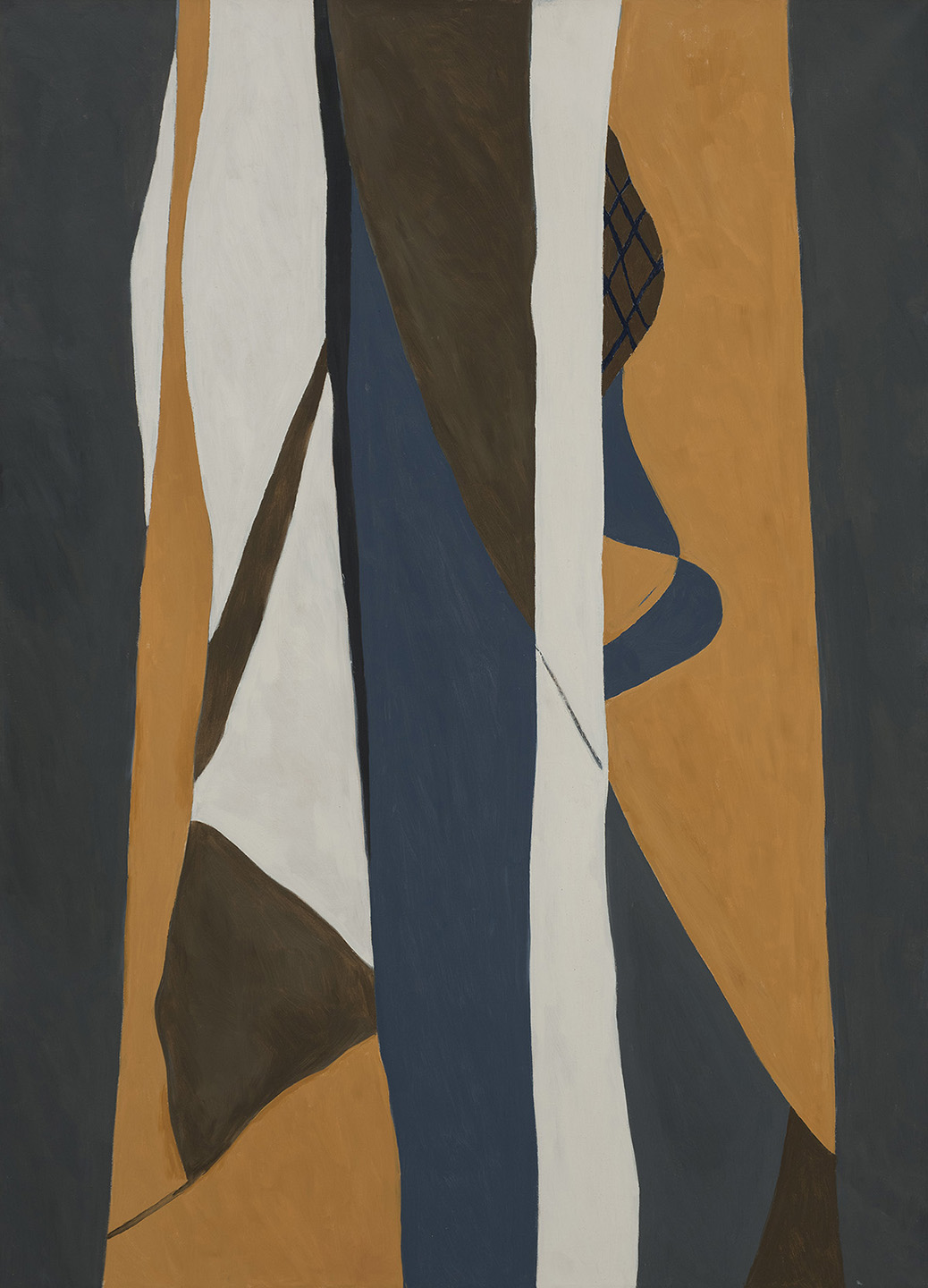
I’m surrounded by paintings and sculptures by Charles Biederman (1906-2004), but New Art City never sleeps and so my desk is cluttered with books on Fairfield Porter. I don’t think Biederman ever met Porter, and if they did, I’m sure it would have been instant and total and mutual enmity – but somehow they are all speaking to each other this evening.

Biederman was born in Cleveland and started as a Cezanesque painter in the 1930s in Chicago. Then he came east to New York, and became a sort of Surrealist. He went further east still, and found himself a disciple of Leger. You can’t pull a rubberband all the way from Cleveland to Paris without it snapping back, and that’s what happened, and then some, and by 1940 he wasn’t a painter and he wasn’t anyone’s disciple and he was living in Red Wing, Minnesota and that’s where he stayed. Around 1940 he predicted that easel painting had breathed its last, and he wasn’t wrong, but he was early. Five years a painter, fifty a sculptor: Biederman toiled away at wall-relief sculptures, abstract arrangements of colored rectangles of wood and metal, until the end of his career.

Biederman saw something deeply scientific about his rectangles though, and some scientists thought so, too. He became good pen pals with David Bohm, a physicist who liked what he did. Bohm saw in Biederman’s abstract play of shapes something science-like without representing science in some pedantic way. Biederman for his bit always said he was drawing ‘from life’ with his abstract pictures, and maybe it’s a vision of the life of quantum physics that Bohm and Biederman shared.

The year after Biederman was born in Cleveland, Fairfield Porter was born in Winnetka, Illinois. Porter went east too, but took a different tack, heading to Harvard and never kicking the oil on canvas habit. Some people just fall in with the wrong crowd, and Porter’s was John Ashbery, Frank O’Hara, and some other writers of note. You could say Porter’s work itself was literary, but that’s probably more to do with all the writers who found their way into his canvases. Really his work remained visual, and like with Biederman, not everyone could see the world the way Porter saw the world. And like Biederman, Porter knew it, and didn’t mind saying so. He too worked ‘from life,’ but Porter must have had a prettier life than the rest of us.

The two of them dug their ways into their work from opposite ends, one toiling at objectivity and making abstraction, the other toiling at subjectivity and making realism. Biederman wrote endlessly about what he was doing, but I think Porter understood the both of them better than either one of them understood themselves.

I came across a talk that Porter gave, and I transcribed the best parts for you to read while you’re at work, so you can decide for yourself:

“Maybe I looked for the idea I already had . . . I wanted to somehow relate everything that I said to students. I think my idea, that I am interested in, it’s something that doesn’t come from artists or art students questions, but it’s something that comes from comments by laymen . . . One of the questions that perhaps that perhaps bother some students, not the best ones, necessarily, is, I think, what is the meaning of what they do. I think discouragement comes, people think, Well I’m doing this, what’s it’s all about? And I think that wondering what something ‘means’ comes from the influence of our environment. We’re asked that now that to study art has become more popular, and we’re influenced by the prestige of science. There’s a difference between art and science and it’s an important one.

“The difference between abstraction in science and abstraction in art: Science is concerned with the general, with explaining, and meaning, and science has influenced writers particularly, and critics . . . and they write about what different art movements mean. They try to apply science to art. When science explains, when it gets to something general, it goes away from the specific . . . it emphasizes the way things are alike. A scientist explaining is also translating – he’s saying, this and this and this phenomena can be explained the law of gravity, Einstein’s theory of relativity. What a scientist means by communication . . . that he can translate phenomena into a verbal explanation. The limitation is that any explanation doesn’t explain; an explanation is actually impossible. An explanation takes you away from the concrete event, and gives you a . . . generality. That is a little different than experience.

“Science has another side, that it is based on experience, that it is experimental, that it is experimental, and the philosopher of science. Art does not look for; art does not explain. To explain art is to get away from art . . .

“I don’t believe that there’s anything important in the distinction between abstract art and realist art. What’s important is that it looks for difference” [Maryland Institute College of Art, 1963].

If that explains the mountain that the two artists were drilling into, one more artist talking about art can bring them back together. In the 2000s, John Chamberlain said in a talk that he didn’t know the difference between abstract art and realist art. All art is by its nature abstract: it’s a picture of a car, not the car itself. It’s all abstract—just an idea, hinted at. Unless it really is the car, and you put it in a giant trash compactor and sent it over to Pace for display.

I can’t find the citation but it was on a DVD that came with a book that Pace put out, and I lost the book and don’t have a DVD player anymore since I just stream, but that remark always stayed with me. I like to think that all three of them, Chamberlain, Porter, and Biederman could be great studio mates up in some astral plane or afterlife somewhere. Porter painting from the model, making the colors too vivid and a little “paint-by-numbers”; Biederman cursing everyone out and telling the model to sit still as he assembled an inscrutable pile of brightly-colored rectangles. Every now and then, John Chamberlain comes along, takes a Biederman aluminum sculpture and crushes it in a giant trash compactor.
Henry Adams on Thomas Hart Benton

On Thursday, May 9, Menconi + Schoelkopf hosted a gallery talk with Henry Adams on the work of Thomas Hart Benton. What follows are excerpts from his talk.

I’m going to thank some of the people who’ve already been thanked, and I think this is a pretty amazing show with masterpieces big and small. But Andrew Schoelkopf is obviously a great dealer and I think what is often underappreciated is the role that dealers play in developing new scholarship and you know there are particular dealers who do that. His father Robert Schoelkopf was also one of the great American art dealers and really a pioneer in discovering under-appreciated American painters. I’d like to thank Clay Surovek in Palm Beach and also Andrew Thompson who has been working for years on the Benton catalog raisonne.

He’s a little bit like Mr. Memory in 39 Steps. If you have a question about Thomas Hart Benton you should really just ask Andrew. Benton was really a unique figure in American culture and it’s sort of ironic that at the time I started work on Benton. He was widely viewed as a sort of hillbilly Yahoo. And he was very far from that. He was one of the great American painters and I think with that much debt the greatest American muralist. He also was a writer of great literary distinction. His autobiography An artist in America is one of the great books ever written in America and one of the best accounts of what America was like in the 1930s. Somewhat surprisingly he also was a major figure in American music. He was really the person who brought American folk music to the awareness. It’s the New York intelligentsia. After he completed his mural in America Today he with a group of students gave a harmonica concert and Pete Seeger once told me that that’s where he first heard the folk song John Henry. It was really Thomas Hart Benton who sort of converted Charles Seeger and Pete Seeger from an interest in more classical styles of music into any interest in American folk music and not incidentally. Benton devised a new method of musical notation for the harmonica where rather than having notes on a staff it shows you what hole to blow through to cover up and to blow through and whether to blow in and out. And it’s an easier way for someone with no musical training to play the harmonica. It’s still used by basically you know her harmonica people who write harmonica music and Benton even produced a record for Decca called Saturday Night at 10:00 A.M. where you get to listen to him playing on harmonica and his son playing a flute and so forth.

When I began work on Benton he was extremely controversial figure and I think that was still the period where people felt that American art with a march towards more and more advanced forms of abstraction and Benton was the devil and the Antichrist. And in fact when I did as Centennial Exhibition of Benton’s work it got widely divergent reviews but some rather negative as for example a critic who said it was the worst exhibition he had seen in 40 years. So I guess I’d say that over the last few decades it’s been exciting to watch I’ve been transformed from the devil to one of the heroes of American art. One aspect of that I think is that there’s a new awareness of his importance to the creations of Jackson Pollock.

And I wrote a book about that—called Tom and Jack—the intertwined lives of Benton and Jackson Pollock. You know when I began my work it was widely thought that Pollock’s association with Benton was a kind of youthful indiscretion like some you know inappropriate sexual affair and that he had turned his back on Benton. And in fact we mentioned that he was basically still calling Tom, and he really in a few weeks before his death. Certainly when the transforming events I think is the key transforming event has been the acquisition of Benton’s America Today mural by the Metropolitan Museum of Art.

And I think what is remarkable is that it’s clearly one of the most extraordinarily paintings in the museum. And I think it’s hard to think of another painting by any artist including people like Picasso where you can stand and look at it for an hour and not be bored and come back a few weeks later and spend another hour looking at it and not be bored.

So yeah I think that Benton is gradually emerging and I might say that he’s a fascinating figure. He came from a major political family. His great uncle Senator Thomas Hart Benton was the first senator from West of the Mississippi. His father was a U.S. congressman. And he’s just altogether a fascinating figure. This is an amazing group of paintings. Let me start off by just mentioning in passing I think that this painting of a locomotive is one of the great American paintings of the 20th century if you had to choose a dozen or two dozen paintings this would be on my list along with things like Hopper’s Nighthawks. I’ve got to say that as an art historian I probably look at things differently than many art collectors do. But anyway I’ll come back to that issue. Pen is a curiously complex and both varied and contrary and figure in American art. And I think that one thing that’s not usually recognized is that in his teens and 20s he was he basically went to Paris and explored modernist directions. And unfortunately you can’t see it from where you’re seated but off on the right hand side there’s a portrait he did of Stanton McDonald-Wright who was one of the two creators of Sinclair miss which is the first start cystic movement created by American artists. And it’s the first group of American artists who read a manifesto and they also exhibited the first purely abstract paintings that were exhibited in Paris Sinclair miss them was a largely developed both by McDonald’s right and also by another young American artist Morgan Russell who had studied sculpture with mentees and was fascinated by the spiral rhythms found in the sculpture of Michelangelo particularly the Greek slave which Matisse had pointed out to him in the loop and told him to study and basically when Morgan Russell discovered cubism he came up with the idea of translating the rhythms of Michelangelo into the fragmented forms of Cubism and then applying modern color theories which he had learned about from the Canadian color theorist anyway.

And when he was in Paris. McDonald-Wright was his best friend. They would go painting every day. Benton basically went through a progression of modern styles starting with impressionism moving to point the listening post impressionism focus. And then unfortunately just before the Zink from this movement was started his mother showed up in Paris found out that he had a mistress and took him home. So Benton missed and missed out on the creation of synchronicity.

But in 1914 in 1916 when McDonald-Wright came back to the United States he picked up the singer from his style and made purely abstract paintings. Benton’s basic contribution to Synchromism in the Synchromist had always dealt with brother a tightly enclosed force and with a single figure is the basis for their composition. Benton translated that into multi figure all compositions and basically explored that throughout the 1920s and that abstract study is what underlies Benton’s work throughout his career. I’m just trying to think of where I should start. But there are some remarkable paintings in this room and this is a painting that was done for actually the den of a sportsman named Briggs who was interested in fishing and that kind of thing. And I think it’s interesting one of Benton’s first modern influences when he was a student at the Art Institute of Chicago he saw an exhibition there of Frank Lloyd Wright collection of Japanese prints. And this of course ultimately goes back to things like Hokusai’s Great Wave and here we have four studies for the four major paintings in that room for which spent and also designed rugs and things of that sort. Ironically though Benton and I you know when I started work on Benton he was described as a mere realist. But he wrote what is probably the best essay I’ve ever read on abstract painting called The Mechanics of Form organization in painting where he talks about different ways of rhythmically organizing forms. And he was particularly active in this kind of exploration. In the 1920s and well here’s a painting from the early 20s he did something rather unusual where this is an abstraction but it was based on models that he created out of wood and cardboard. So it’s a kind of realist abstraction if you would we might say but Benton was particularly interested in creating a kind of vertical organization with forms that spiral around that.

That’s something that you see throughout his paintings and there’s an interesting late painting over the mantelpiece where you can see that very clearly illustrated and what in his murals he tends to do is to have a vertical pole with spire—and then just to extend that across the composition and of course that’s also the form of compositional organization that you find in Jackson Pollock’s Blue Poles his famous painting and apparently Benton was still alive at the time that was sold to the National Gallery of Australia. And remained a friend.

Benton throughout his life was fascinated by trains and in fact the earliest work by Thomas Hart Benton. A drawing that he did when he was nine years old when his family made a stopover in Forney to Oklahoma on their way to Texas to see his grandparents and he sketched a locomotive. And it was so impressive that the ladies that they were staying with saved it. And it is so accurate. It’s a record. It’s a rendering of a locomotive that I showed it to a Kansas City Railroad expert and he was able to identify the precise locomotive that was represented that in fact this is a drawing that was done in December 1898 and it turns out that locomotive was scrapped in January 1899 so that we know that the date of the drawing must be accurate it’s not something that was reading it later Benton’s forebear.

Senator Thomas Hart Benton was coupling with a major advocate of the Transcontinental Railroad. And I think this is a fascinating opinion. It relates to the central panel of instruments of power in the America Today mural in the metropolitan museum and well as I say you know if you think it’s mere realism. This is not exactly the way a real locomotive looks. There is an extraordinary modernist kind of distortion of form and I think it’s kind of an emblem of America. It’s a kind of extraordinary record where America of course is this vast continent and which was much larger than any country that had been put together in a connected way before.

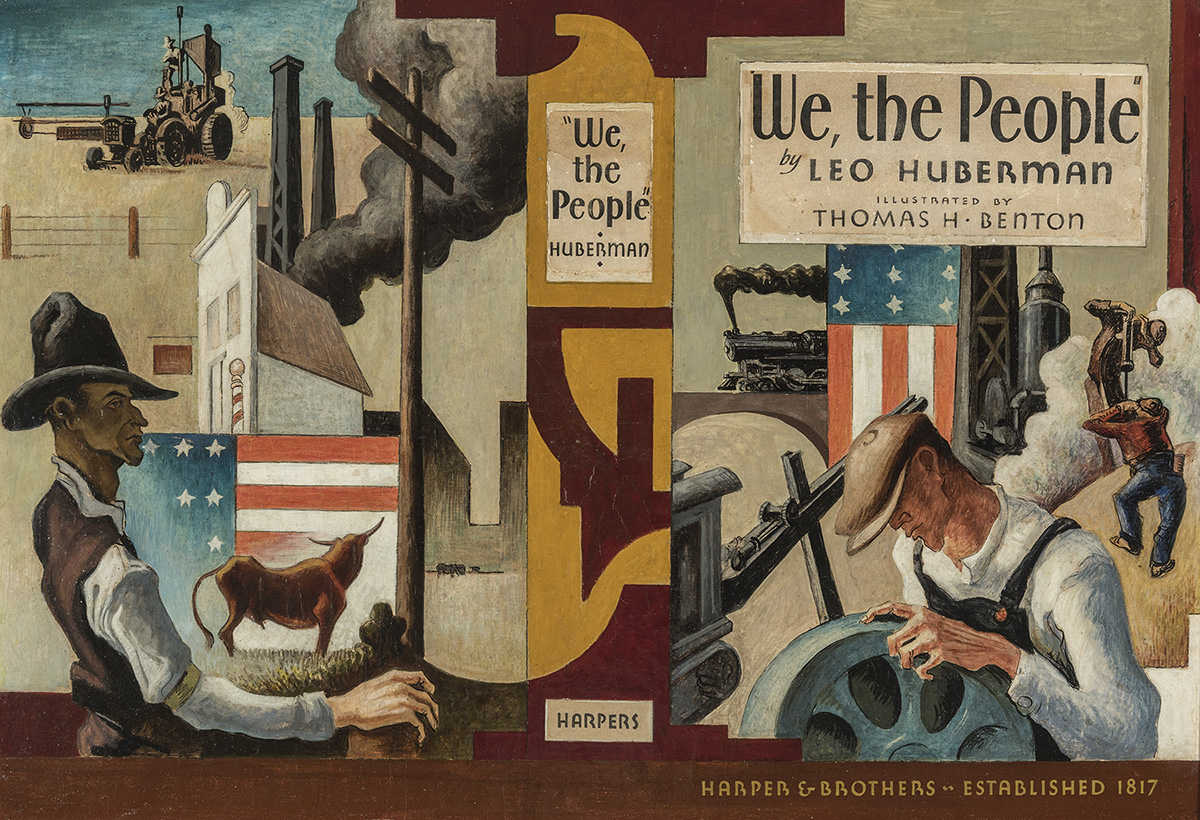
And here you have the locomotive probably going to close to 100 miles an hour which is the thing that’s making a connection across these spaces. And then you have these telegraph lines which are suggesting the way electrical impulses can communicate even more quickly across these vast distances. And I guess as I say art historians look at paintings probably differently than private collectors do. But I would have to say that if I was thinking of a cover for a survey of American Art this is a painting that I would consider seriously for that role. It seems to me it’s a wonderful sort of mythic representation of America and the things that are peculiar about America. This is the cover design for a book written by one of Benton’s friends Leo Huberman.

A book called We The People which interestingly given the view that Benton is often castigated as somehow politically reactionary it’s a Marxist history of the United States which is basically using Marxist theory to talk about the relationship of different regions and so for a thing is actually very illuminating if you want to understand this thought process that goes behind the mural like America Today. But this is one of my sort of favorite moments in Benton’s work where he has realistic imagery but is putting it together in a kind of quasi Cubist collage and even has a piece of paper that pasted on for the people title and this is a painting.

It’s easy to overlook. People often say that paintings representations of African-Americans are stereotypes and I think that if you just go look at the America Today mural you can see that that’s obviously untrue. An interesting why many African American artists such as Jacob Lawrence it seems to me do represent African-Americans in a stereotypical way. But if you look at the America Today mural I think one of the things that’s clear is that every one of those figures is an individual person who whose physiognomy Benton studied very carefully and there’s an extraordinary variety of facial types. And I think that this is it Benton clearly thinking back to people like Shaw for us when the guy who had represented the lives of French peasants.

But I think this is profoundly just it’s amazing how with such seemingly simple means Benton manages to capture what it’s like to be a downtrodden working person and to try to do that and retain your dignity.

I think it’s a very powerful painting. I’ve probably spoken long enough but I might mention I insisted and Andrew struck up was showing me some opinions this afternoon I insisted that he lose them out this evening is an extraordinary Winslow Homer watercolor which is very fresh in color and also one of the greatest watercolors that journal fresh ever did. If the Senate sees this or other organs of work done so I’m sure many of you know more about time start and then I do and I might say that one of my regrets is that I never met him.

I grew up in Massachusetts and if I knew him many years of my life I would be wasting writing at that time a certain point and I would have gone and asked him some simple questions which I’ve been unable to figure out. I have gotten to know Jesse Benton his wonderful character and um yeah quite an inspiration.

So I don’t know if any of you have questions, or those questions where it takes 20 minutes to ask the question . . .

[Audience member asks about the materials used in Benton’s America Today mural].

I am not going to try to explain all of that but I can explain the basic system. Benton liked to paint with tempera and I think there are two reasons for that. One is that Benton was a fast moving sort of impatient person and temperate dries very quickly. And the other is that he had looked at Old Master paintings and at some point it occurred to him that the older they were the brighter the colors were. And then he figured that the temper holds its color better than oil does. Most of Benton’s paintings are a mixture of tempera and oil glazes and basically the tempera provides the brilliant color and the large forms but if you put oil glaze over it you can get more subtlety in a richness of detail.

Generally speaking I would say that the earlier periods of the 20s and early 1930s don’t have too much oil that’s applied oil paint that’s applied to them but by the time you get to about 1939 when he did pour softening he became very interested in creating a greater intensity of detail. And at that point and I guess I’d say because it’s a mixed media technique you can have the same painting described by different people as a temperate painting or an oil painting or an oil and temperate painting. I’m painting basically used just said canvas over plywood. It’s something like the America Today mural has had modern restoration so that’s where the honeycomb panel comes from. People sometimes criticized Benton for not using a fresco technique. Basically when he was commissioned to do a mural he would create these wooden panels which were quite laborious to construct and then stretch canvas just that canvas over them and paint and temperature. If Benton had painted in fresco many of his paintings wouldn’t be around today. There’s something one of paintings murals since the 1930s that’s still in its original location which is a mural if he did for the state capital in Columbia Missouri or rather Jefferson City Missouri and something like you know America Today has been taken out the Indiana mural office and move to a new location mural he did for the Whitney Museum they sold for five hundred dollars to the New Britain Museum of American Art at a time when Benton’s work was very out of fashion.

[Audience member asks what questions Henry Adams would ask Benton if he were still around].

I might say that I just continue with that the conservation of Benton’s work is a little bit of an issue because tempera is a very brittle service so it picks up cracks. And that was noted early on with Benton’s paintings said that a lot of Benton’s artworks have cracks and there’s the potential of flaking out. Usually I think that doesn’t happen. Cracking up sort of allows a little bit of give so that it usually doesn’t like very much on the other hand I would say that five hundred thousand years from now when most oil paintings will have significantly deteriorated in color Benton’s opinions well all look just as brilliant as they do today and it’s always seemed to me that the cracking sort of goes along with fans who helped build a persona and you know that kind of energetic roughness that seems to have been part of his temperament. That’s obviously very sort of a hot button issue. Benton’s political background is very intriguing which is not untypical of coming from the south. His father my seen this Benton actually fought in the Civil War fought the Confederacy but then later made most of his money as a lawyer representing union soldiers who had pension claims. Jesse Benton was the daughter of Senator Thomas Hart Benton who was on the Benton. Great uncle or Senator Benton was Benton’s Great Uncle Jesse Benton married the Western explorer Charles Freemont who was the first presidential candidate to run on in anti-slavery platform. Senator Benton actually owned slaves but opposed the extension of slavery and was eventually defeated for re-election because of his opposition to the extension of slavery.

I mean you’re basically dealing with a highly argumentative contradictory cultural situation and I might say that Missouri was the center of warfare both before and during the Civil War. I think there’s no question that Benton was liberal on ideas about race and he stated that rather explicitly on a number of occasions when it’s an interesting footnote to his career is that he was largely raised by an African-American woman named Mariah Watson who was also the person who raised the African-American scientist George Washington Carver said that dealing with African-Americans was very much part of Benton’s daily experience growing up.

It is sometimes maintained that Benton caricatured African-Americans in his murals. It seems to me if you look at them that does not seem to me the case and it’s interesting to me that figures like Picasso who represented African masks as something, you know, violent and crude and primitive, are still people who basically had a kind of colonial view of Africa are still artists who are revered. It seems to me a lot of what the America Today mural is about is the fact that people in East Coast cities are relying on the work of people in the south and the West including African-Americans who are not getting we’re not getting very well paid or very well rewarded for that.

Interestingly in the early 1930s Benton attracted a large number of African-American students who worked with him at the Art Students League. That changed in the later 1930s and I’ve gone into that a little bit in my book Tom and Jack but basically Benton was quite early in his opposition to Stalinism. Now one is the can tenuous controversies about Benton has to do with the fact that he represented the Ku Klux Klan in his Indiana mural and basically he came in at a point when I think most of us are aware that at one point the clan dominated Indiana politics including the governor and the state legislature and they basically were defeated through an exposé by the press and the Indianapolis paper and Fenton basically is representing reporters in the foreground. Is an African-American girl getting hospital care and then there is a Klan rally in the background.

And if you want to pursue that I wrote an essay for something about it called The Conversation about that mural and then Jesse Benton wrote an essay which you can easily Google called My Father Painted the Truth, but she’s rather eloquent about the fact that in Kansas City at a time when it was a very segregated community. You know, her father would have things like African-American people for dinner at their home which is something that was not done in most families in Kansas City at that time and which caused a lot of negative comment. So it seems to me that this is something that people have gotten completely backwards and I think that at a time when Benton was viewed as the follower of abstract painting even though ostensibly you were supposed to leave biography out of the judgment or works of art. I think that there was a real very conscious effort to sort of vilify and defame him and very much the view that anyone here has a Southern accent has to be a bigot and that we can just dismiss people on that basis. So that’s the way I feel about it. Obviously all these issues about gender and race are very sensitive and you know it’s sometimes difficult to process to figure out what causes offense and whether that was intentional or. I think a lot of it just has to do with dating paintings and that kind of thing. And you know a new painting comes up and I’m trying to figure out where it fits in. And um yeah I’d love to you never know more about its relationship with Jackson Pollock and that kind of thing. Fortunately he was a remarkable writer and um at the time of his death was working on an autobiography called the intimate story where he gets into got quite intimate matters about his. The temptations in his family and so forth so that he is someone who’s left an extraordinary record.

[Audience member asks a question about Benton’s sketching practices].

That’s complicated but I think that there is some psychological and emotional element of it. And the turning point occurs in nineteen twenty four when Benton went back to Missouri to visit his father who was dying of throat cancer which of course is sort of strange cruel for someone who had been a politician. You know what. It had basically lifts were his words. But at that point at his father’s deathbed Benton had some kind of wish to reconnect with the world of his childhood. And in nineteen twenty six he took a walking trip through the Ozarks and then went out to border Texas and made drawings and then in nineteen twenty eight he basically set off with a student and left his wife for more than six months with no news about when he was going to come back and travel around the United States making sketches.

And that’s when he provided the basis for his America Today mural and I think that at some level he felt that there were things he wanted to express through his paintings that he couldn’t express in an abstract in a purely abstract language so I might say that I mean one of the interesting things is she did produce pure abstractions throughout his career. And um and was very encouraging. You know in the early phase as a career Jackson Pollock said. I think that one of the things Benton was trying to do in America Today mural was to combine modernist form in this sense of a essentially Cubist mode of—or it’s sort of a formal organization with Marxist subject matter said that he thought of himself as combining these two elements of modern thought – of course he later turned against Marxism because of Stalin, I think was and there you get into a very interesting thing because Benton’s father was a populist and a supporter of William Jennings Bryan.

And I could probably talk for an hour about populism and try to figure out what that’s all about. But it’s very much Benton. He grew up in a household which was very suspicious of corporate and government authority and had a sort of instinctive frontier rebellious stance to it. He was mostly in Paris and I’m just trying to remember that in more detail. He was in Paris. He spent the summer before he returned to the United States in the south of France. I don’t think he traveled outside of France when he was in Europe. He later in his life he went back and traveled but in France and Italy. But that was much later.

But he certainly knows about collage. And there must have been other people working with the assemblage at that point. I think it is interesting that Benton and we had a pretty informed understanding of modern painting particularly through the 20s. But I mean things he did in the 40s clearly shows the influence of people like Salvador Dali up through the late 1940s. I think Benton Stone regarded himself as a modern artist. And then of course after World War Two the whole climate changed and I mean it is sort of interesting. I think that when abstract expressionism came in it was almost like a Stalinist purge. And you know there was this great desire to get rid of these people. And I’m almost like that period in Russian history where you know there’s a portrait of Stalin with all his henchmen and then when sum gets axed out so you need to paint that guy out as a portrait of it maybe put someone else’s face in.

There was a fire that burned down in the family home in 1917. I was just going to say I guess I never needed time to start betting but I knew his sister Mildred Small and she vividly remembered for example a self-portrait he did in Paris which she said looked like a mule. And that she remembered as the first painting that she was ever interested in that most American paintings at that time were very sort of brand not very exciting to a little girl. But this was a portrait that really caught her imagination but unfortunately it was burned up later.

I’ve got copies of that essay say if you want to see it and it is hard to find. And Benton basically in The Mechanics of Form organization proposes that there are two ways of analyzing the composition.

And he proposes a method for doing it so you can take an old master painting and you can imagine it is a design on a flat surface and rhythmic lines which ends up looking a lot like a Jackson Pollock painting and you can also translate it into cubes which is a method actually used by an old master draftsman called Luca can be also if you use this method it was also used by door and other people and it’s actually a fairly hard kind of drawing to do because you need to basically look at an old master painting and conceptually understand that and not draw lines that you see but that correspond with where cubes are sitting in space. And if you do this exercise you start to see the rhythmic organization of the form and then in The Mechanics of Form organization Benton basically proposes different methods for doing composition. I might say that if you look at Jackson Pollock’s early drawings they basically follow this method of cubic analysis that taught him and Pollock was very influenced by figures like El Greco who had a great deal of rhythmic movement in their work. I did something I should have said is that interestingly Benton designed his paintings and clay models and his basic process for example with the America Today mural is he went out and did life sketches traveling around America. Then he came back and organized the life sketches into categories and so forth and made a claim model as his first integrated study of the design. He would then paint the clay model and do analysis of the composition both in color and black and white and then once the whole composition was worked out he would do life studies since the individual figures to work out the anatomy with more accuracy than he had been able to do in his life sketches. Interestingly Jackson Pollock arrived in New York in 1930 just as Benton was setting to work on his America Today mural and Pollock did what was called to action posing for the mural. And his words he basically posed for the figures studies for that mural and I can’t absolutely prove it but if you look at the figure in the foreground as the steel panel it looks very much like a portrait of Jackson Pollock. And in terms of understanding Pollock’s paintings it’s interesting that he not unlike copied painted in style but had actually been have figure within Benton’s major murals and within some of his major paintings it’s right.

Benton made them often plasticine clay and he would just break them up and get rid of them afterwards. At the end of his life a few of them were cast in bronze and there. I know of two models that survive in plasticine one for very light murals. There’s a painting at Yale. There’s a study for the plasticine and that’s it. The Milwaukee Art Museum, and four places, but mostly Benton had this sort of secret career as a sculptor.


American Art and Game of Thrones

There are only two camps: those that haven’t watched yet, and those who are obsessed. That includes Americanists—and why not? The near-decade of TV is the ultimate American retrospection fantasy: a guy from Bayonne, New Jersey creates a gritty facsimile of medieval Europe (eg: “I wanted my books to be strongly grounded in history and to show what medieval society was like,” says Martin), adding realistic elements to ground the mythic ones. (You know the mythic ones: dragons, magic swords; zombies; the realistic ones include practical power struggles, intra-family bickering, and, I guess a yearning for parliamentary democracy?). Westeros—I’m hoping but not guessing that I haven’t lost the few readers from the ‘never watched’ camp—is an entirely fictive rehearsal of the globe, but it has everything: the nomadic hordes of Asia; the exotic Middle East; a Brexit problem made worse by frustrated relations with the Scots—the works!

For centuries, American painters have been mythologizing America—now America is repainting the myth of the Old World.

Just one thing missing from the picture: the Americas.

Sure, I know that this is the world Martin has conjured, he can conjure it any way he wants, and he wants the Pre-Columbian Europe. But there’s a sort of continental psychology implied when one continent imagines a mythic world that does not include itself, right? Call it a portrait of an absent parent where a family photo is wanted. It ascribes attributes that go beyond what it would say about itself, good and evil. And at the same time there is an insistence on realism, even though we all agree we’re just engaged in speculation, fantasy.

Not even the Many-Faced God knows what George R. R. Martin is thinking, so why speculate? The show does say some fascinating things to us in the world of American art, and I think those lessons are worth enumerating.

The beginning of the final season of Game of Thrones was anchored at one end by a monologue about the motivations of the Night King. Why does he want to kill Bran, the Three-Eyed Raven? Sam explains that Bran is the memory of the Realm—he is a living encyclopedia of the deeds of heroes, the seer of secrets; that memory, Samwell says, is more precious than anything else the realm might hope to possess, or fear to lose. That’s the Night King’s goal, Sam explains: not just to kill everyone, but to kill the spirit of humanity by snuffing out its candle of memory—Brandon Stark.

Fine sentiments, but more telling is who is delivering it: Sam Tarly broke his vows on several occasions and left Castle Black for the Citadel in order to study to be a maester—the  equivalent of doctor and research scientist combined. Sam has spent a few seasons in close contact with a different facet of the Memory of the Realm. Midway into his training, we are treated to one of the few moments of poetic beauty in the entire show: a triumphant shot of the Citadel’s library, radiant in shafts of golden light. The hall is adorned by the astrolabe from the opening credits, so you know this moment is sincere: this is another manifestation of the memory of the people—its library.

Why doesn’t Sam speak up for the library he so loves? That is, if why is Bran so important if books will do what Bran can do?

Apart from that one swooning moment, the life of a maester in the library is shown to be mostly chamber pots and gruel. And indeed, Sam’s books provide as much as Bran ever does to help save the day: the cure for grayscale that saves Sur Jorah, the true heritage of Jon Snow – these are found in the stacks, only to be confirmed by Bran later on. Sam doesn’t speak up in defense of the library, or even books in general, and why would he? Libraries are Palaces, yes – palaces of intellectual authority, and their priests are as corrupt and implacable as the High Sparrow.

So is there anything that Bran, “Memory of the People” Stark accomplishes with his “power” that isn’t done better by something hidebound?

Just one thing, apparently.

Unlike Tyrion’s impassioned plea at the series’ conclusion, Sam isn’t saying why he likes Bran – he’s explaining why the Night King wants to kill Bran. And whether or not Bran makes a good king, he certainly makes good bait.

He’s the foil to the Night King’s plan – but what is that anyway, and, apart from existential terror, why does anyone care?

Certainly the Army of the Dead is a terrifying force, able to kill and kill and kill – but so is Cersei, Daenerys, and the vast armies of the living. For the average Joe on the street, why is it better to die in the thousand ways that people die on the show than at the hands of the Night King? For that matter, why aren’t there any turncoats to the Whyte Cause, as there are traitors between houses like Jamie and Tyrian Lannister, Theon, and Varys again and again? The Night King silently provides what the Red Priestesses only promise: resurrection.

Resurrection is everywhere in the Realm: Jon Snow of course; Berric Dondarion is quietly revived a round dozen times. Then each house has a promise of eternity, a way of transcending death: “What is dead may never die,” say the Ironborn, after simulated drowning; “A Lannister always pays his debts,” proof that accounting lives on; and then there’s the whole House of the Undying. What do we say when the Lord of Death comes for us? Death is but a stage in the ongoing story of life.

Jon Snow says there’s no afterlife – just blackness – for mortal death. Why aren’t there at least a few people who would be willing to join the Night King in icy eternity?

The show talks about the white walkers as if they are a personification of Death itself – but what marks you as a hero in this world is a shrugging indifference to death itself. I’m not asking ‘why are zombies scary?’ I’m asking: why are zombies scary to these people?

Jon Snow doesn’t articulate it very well when he makes the case to Cersei, but then, Jon Snow doesn’t articulate anything very well.

The real problem with the White Walkers is not that they’re dead, and not that they are obedient automatons, but that they are memory-less objects. They have no relationship to the past, and the sprawling eternity before them is undistinguished by goals to achieve or debts to pay. It’s that they have achieved immortality that is frightening. Death is a force that gives life meaning in the realm; the White Walkers are the ultimate antagonist in the Realm because they kill even Death.

And so, the Night King wants to end Bran first. I guess the idea is that, just as killing the Night King will dis-enchant the reanimated corpses at his command, ending Bran will dis-enchant the living of their own living history.

In the Realm, objects have memory: here, a blade of Valerian steel, the one that was intended to assassinate Bran Stark in Season 1, was then used in a string of frame-ups by Little Finger, finally finds its way into the hands of Arya Stark. Sure, it’s magical, but it’s an object with memory. Only it can kill the Night King; only here, and only by these hands. The artifact places Arya here, in this moment.

The Army of the Dead—the forgetting fact—is destroyed by the object that remembers, the artifact that teaches.

So even tho the library is full of books, they are chained up by the master maesters (or whatever they’re called). They preserve memory, but they don’t engage it. Books don’t kill night kings: only Arya can; only with the right kind of artifact; only here. Not because she is a princess; not because the blade is magical: because she is activating history.

This is what happens when you stand in front of Frederick Church’s Heart of the Andes, or Jacob Lawrence’s Great Migration or Judy Chicago’s Dinner Party. Do you learn facts about the world? Not really. These aren’t maps, or Wikipedia entries, or cook-books. It’s not evidence, although you can sometimes use a picture to substantiate a claim. Facts are dead things – excel tables that can be consulted and abandoned; write things down in order to forget them. Not so a painting: it must be felt to have any meaning at all. It calls to mind a summer evening; it finds catharsis in a bitter reminiscence; it returns to you the departed. When they are engaged, they place you in your in your time and in place and in your self.

This lens is an important one, especially for Americans thinking about American art. There is newly vocal popular concern about monuments and public works of art, along with new interest in re-introducing forgotten voices to the conversation. How to present and shape the narrative of our own history has never been more hotly debated, with artists and curators grappling the ugly chapters in American history and anxiety about the American future. Debate surrounds the display of public murals of Thomas Hart Benton, the work of contemporary artists like Dana Schutz, and the inclusion of artifacts from non-Western cultures in challenging contexts. Karl Kusserow, curator of American art at Princeton University Art Museum, is promoting the idea of “econ-criticism” – investigating American art via its relationship to ecological concerns. Museum curators across the country are scrambling to expand their representation of African-American artists and works by women. That these initiatives are ensnared in thorny matters of identity and ownership demonstrates the ability of these artifacts to engage our memory.

None of these discussions overturn the value of American art—from my perspective, they strengthen the case for close-looking. The business of art history, curation and criticism is not about handing out medals: it’s about understanding and contextualizing so that you can have that one-on-one dialogue with an artwork. That can be unsettling at times, but ultimately it helps you locate yourself within your time and place.

This is what art historians, curators, and collectors do: activate the story of ourselves through artifacts. Our history and heritage and culture, demons and angels included, can be preserved, just as the Night King or the Citadel can preserve lives or books, in icy disuse. The idea that your past and your future can be reduced to metrics represented by a Google Doc or tallied in Facebook likes is the Night King’s pitch to join his army. We can’t live in a meaningful way without engaging the memory of objects, and the objects have no meaning without being animated by our engagement with them.


The Power of Moonlight

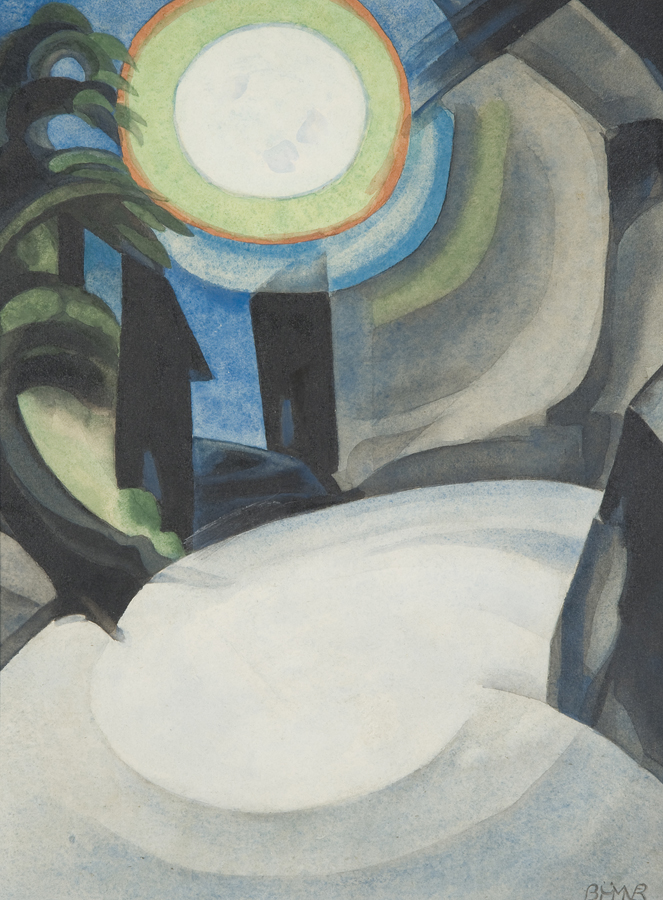
The Color of the Moon: Lunar Painting in American Art, at the Hudson River Museum, Yonkers. The earliest work is from the 1820s—not because that’s the earliest sighting of the moon, but because that’s about as early as American art appreciably goes. On the other end of the timeline, the show ends in 1969: the momentous year of the first moon landing. For millennia, humans had gazed upon the celestial body; pondered; celebrated; trembled with fear and with delight. But it remained that: a celestial body. Is it a god? Near us or incalculably far? Made of cheese, or cold hard stone? The Hudson River Museum rounds up a stunning revue of visual responses, testament to the most democratic thrill of all: looking up to the sky on a moonlit night and being filled with wonder, the world around you remade in bluish midnight glow.

But before 1969, that thrill of contact was strictly visual. It’s one thing to behold, another thing to hold in the hand. That’s a good stopping point for the show, and you can make the case, implicit in that limit, that in 1969, everything changed. One of our species had set foot on the thing—a giant leap for mankind. The facts in the universe had changed forever: now there is an American flag flapping in the breezeless night above us, planted in lunar soil. Something of an art, something of a sport: some things you compete for, some things you do just to see if you can. Some things you do to show that you can. Competition, advancement of understanding, novelty, demonstration: these are the reasons we make art, too.

Of course, some disagree. With all of it—not just the nature of art, but the whole enterprise, the facts of the matter. That American flag on the moon? Why does it seem to flap in the breeze—when everyone knows there is no breeze on the moon? American rockets were surely advanced, but were they advanced enough to actually put someone on the moon? More important: were they more advanced than America’s true greatest strength: the propaganda engine of Hollywood? Surely the most efficient way to convince the world that Americans are on the moon is to just make a movie about it—not to actually do it, right?

It is a rustic comfort to observe today that fake news—even conspiracy theories about fake news—isn’t new at all, and the theory that the moon landing was staged on a back-lot in Anaheim holds just that folksy allure. My favorite theory holds that Stanley Kubrick filmed the fake landing, and then tried to reveal his ruse to the world in clues buried in his 1980 film The Shining. Truly a conspiracy theory at its baroque zenith.

But if there’s a sympathetic underlying attraction to the urban legend, it’s this: the delirious joy of moving from beholding to holding is an unreportable change: Neil Armstrong walked on the moon, but I still just look at it. The important thing is not that the moon got walked on but that the man did the walking. An experiential change took place, but only if you are that particular man; or, maybe, if you identify with that man. (Some don’t: you can imagine that other nations, folks of different political persuasions, might feel a different tingle to know it is an American flag dangling in the airless night above them. Or one giant leap for a man, but woman is still down here staring up at the moon through a glass ceiling.) For the rest of us, it can inspire our imaginations – a man has walked on the moon!!! – but that statement inspires the imagination whether it is true or false.

What I share with the conspiracy theorists and discontents broadly is that contact is marvelous, but it needs to be yours. When a man set foot on the earth’s nearest neighbor, that contact could not be reproduced, demonstrated, proven, to anyone else, no matter how good Stanley Kubrick was. Contact is irreproducible.

Part of the reason Kubrick was thumbed as the agent of the faked moon landing was that Kubrick was working like a maniac on his sci-fi epic, 2001: A Space Odyssey. As much as anything, this movie, too, is about contact. In the famous opening sequence, with Thus Spake Zarathustra blaring, a tribe of apes encounters an enormous black stone. They tremble and cavort; they touch it, retreat from it, and are drawn to it again. In the moments that follow, the leader of the tribe of apes – the script calls this character “Moonwatcher”—makes two odd leaps. First, he discovers tool use – this bit of discarded skeleton is now a weapon! Then, as the music swells, he seems to discover abstract thought, crushing skulls as Kubrick match-cuts between living and dead animals to show Moonwatcher’s imagination at work. Shortly thereafter, the match-cut is deployed again, as the flying bone becomes a soaring satellite, and the audience is ushered into the future.

As with all matters Kubrickian, there are a lot of theories about what takes place in this dialogue-free twenty-minute sequence. The best accepted are: that a super-advanced alien race placed the monolith on earth, and the monolith itself taught the apes how to use tools; or, that a super-advanced alien race recognized that the apes were about to discover  how to use tools, and, satisfied that they were ready for a quantum intellectual leap, presented them with the monolith as a welcome-basket to the universe of abstract thinkers.

Personally, I favor a third theory, even more esoteric: apes encounter this enormous slab of perfect craftsmanship: obsidian and relentlessly matte; it soaks up sunlight. Its edges are straight and cut with a form that God never chooses, an arbitrariness of aspect that is both more capricious and more rule-based than anything found in nature. Like an Ad Reinhart canvas, its inky blackness gives way to subtly blacker blacks. The size of a wall, it is nonetheless not a wall; it offers no shelter, no shade; it bears nothing, and does nothing; it seems to be implicitly decorative just by its design. Decorative, and yet profound, portentous. It is 1 foot deep by 4 feet wide by 9 feet tall: the square of the first three cardinal numbers. In short, it is an awful lot like the paintings that a sophisticated art-lover might find in galleries in 1969.

What can it mean? I don’t think that the monolith is a machine that somehow radiates energy and teaches the chimps how to use tools. I think that engaging with this object of extraordinary craftsmanship – in a word, artinspires the proto-humans, just by virtue of its elegant design. It’s a sort of futuristic technology, but a passive sort of social technology that requires you to put psychic energy in before you get anything out.

Remember the first time you stood before a really great Rothko? What was in it, apart from canvas and pigment? It’s an object of such technical simplicity that we don’t think of it as advanced information technology, but that’s just what it is: the product of years of careful, painstaking thinking, parceled out in laborious craftsmanship, to convey something just beyond the artist’s grasp. That something calls to me, also just beyond my grasp: something calls to you from just beyond yourself. You can’t put it into words; that is a technology either too clumsy or too inelegant to aid you in this terrain. You feel inspired, but shrink in humility even from that word; “inspiration” is a quality you reserve for the magician who made this.

That’s how I interpret that moment. The apes have an encounter with a great artwork. It changes them.

It’s about contact.

It is the fiftieth anniversary of 2001: A Space Odyssey and the Apollo missions to the moon. The impressions of fifty years prior to those extraordinary leaps are recorded at the Hudson River Museum, among others, in the elegiac paintings of the moon by Oscar Bluemner. “Art and Space are a creative duality,” he wrote, in a century ago [Oscar Bluemner, “In other Words,” Bourgeois Galleries exhibition catalogue, 1918]. “Knowledge is a flat thing, as canvas. Feeling is Depth, like Space. Painting is a problem of Deep-Flat.” As he produced modernist masterpieces devoted to the glowing orb of the moon, he reflected upon the importance of immediacy of contact:

“‘Unless you feel it, you will never grasp it.’ In selfless contemplation only we learn to see – with our eyes shut. The humble life-drama of a flower evolves in form and color no less significantly than that of mountain, sea, or star. Creation is projection into space” [Ibid.].

In addition to the orbs that possessed him for a few years, Bluemner, too, composed an epic narrative of the Dawn of Man (“Once long ago before the cave age . . .” begins What and When Is Painting? Today, 1929), but his summary notes on his own sketches are more telling. He made endlessly annotated sketches, carving off forms and then remarking on colors, producing a paint-by-numbers process that generated his final canvases. But this was a mediation, again, of the deep and the flat: you might use up all of your words and still come no closer to expressing the majestic simplicity of the color red. Write all you like – and Bluemner wrote a lot – but contact needed to be made with the work of art itself, visually.

In the end, Bluemner knew as much about the moon as Neil Armstrong or Stanley Kubrick. This is the ultimate lesson of painting in the twentieth century: there is an endless deep-flat problem, an anxiety that life itself might be replaced with a facsimile – be faked, plasticized, or reenacted.

The movie 2001 ends with a wordless series of scenes in which the astronaut, Dave Bowman, encounters himself, again and again, growing older each time. He sees himself from his space pod, standing alone in a Victorian room. His older seems to hear his younger self stir; he looks back to see, but – there’s no one there. He peers into the next room to see another future self, now older still, dining at a table. The diner feels a presence, and looks back, over his shoulder – again, he is alone. He drops a fork; he stoops to pick it up, and catches a glimpse of himself, finally dying in a hospital bed. If that final, dying man sensed the presence of the diner, we don’t see it register. Standing, black and stolid, at the foot of his bed, is the monolith. A flat thing, like canvas; deep-flat.

This is how we hear history: we look ever forward, glimpsing around the corner, interrupted occasionally by the rustling of the past. We look to see our past selves, but no one is there: we are alone, with our artifacts.

The goal of this blog is to heed that rustling – to peer backwards and trace, with satisfaction, the timeless objects that inspired us to look a little further into the future. An article of faith is that there is something special to the human experience that simply cannot be translated, recorded, or replaced: the element of being there, and seeing for yourself. For this reason, among others, we prescribe first-hand contact with finely crafted objects. The idea of a painting, no matter how simple, will not replace stepping into the room with it.

That was one thing Bluemner railed against: don’t try to imitate the moon—you’ll only fail! But try to write some music, paint a picture of some imagination, composes lines of poetry: you may just succeed in raising the hairs on the back of your neck, as with the power of moonlight.

A Ralston Crawford Renaissance

We’re in something of a Ralston Crawford literary Renaissance. I’d say, “It’s about time,” but that’s a peculiar thing: some four decades after the painter-photographer’s death, why now?

Some careers, especially long ones with twists, take a little distance to come into focus, of course. And some take a shifting landscape of taste to be accepted into the firmament, or just an opportune moment to be rediscovered —like Hilma af Klint or Vivian Maier (the question was once asked, with withering irony, ask why there are no great women artists; there’s been a small but meaningful shift in the barometer of justice that even that provocation seems jarringly retrograde today). Still others find a reappraisal fueled by commerce: ‘We used to think that Picasso got bad at the end,’ a dealer once told me. ‘Now,’ that there’s nothing left but the late material, ‘we know how great he remained.’

But Crawford has none of these. A Canadian by birth, he travelled extensively, made prints, photographs, drawings and paintings, served in the military when called, lived a good and reportedly happy life, albeit possibly shortened by unsafe exposure to nuclear radiation when observing the atmospheric test of a nuclear weapon. He had early success, sold well throughout his life, had a family and was, as a recent book declaims, ‘an artist’s artist.’

To be clear, the question isn’t, ‘Why a Crawford Renaissance?,’ for his work so richly deserves it.

The question is: ‘Why now?’

Crawford’s work enjoyed the coffee-table treatment in the artist’s lifetime, in the form of an oversized book on his lithographs [Richard B. Freeman, The Lithographs of Ralston Crawford, 1963, University of Kentucky Press], and, a few years after his death, a big book on the paintings [William C. Agee, Ralston Crawford, 1983, Twelve Tree Press, Pasadena, California]. A slimmer volume, 1953’s cloth bound edition by Freeman [Richard B. Freeman, Ralston Crawford, 1953, University of Alabama Press, Birmingham], serves as a mid-career catalogue raisonne. In 1985, Crawford got The Full Whitney, with extensive retrospective and monograph by Barbara Haskell [Barbara Haskell, Ralston Crawford, 1985, Whitney Museum of American Art, New York].

The last few years have been a crescendo of printed pages. All have accompanied exhibitions, but they haven’t been blockbuster shows at international-tier museums. But they have presented extraordinary scholarship, shine light on different facets of the work, and each has been beautifully designed and produced. It’s an important thing: a catalogue of an exhibition will have a life beyond the show, and if the museum is, say, a modest university organ in a remoteish plains-state and doesn’t travel, the book may be seen by many times the number of people who see the show.

I missed Ralston Crawford: The Artist’s Eye at the University of Wyoming [Susan Moldenhauer and Nicole M. Crawford, Ralston Crawford: The Artist’s Eye, 2014, University of Wyoming, Laramie], but the accompanying book is a fresh look at Crawford’s work across media. The show presented Crawford’s work in film, and makes use of QR codes to link back to multimedia presentations on the museum’s website—a grand use of modest technology, decidedly not at the Whitney’s disposal in 1985. The films – whether projected on a screen or popping up via QR on your smartphone, are mesmerizing. Just when you start to get bored by the incremental creep of a shadow across a wall, the slow wave of band of paint reflected in the surface of a lake, you realize you’ve never seen anything quite like it. They play on that very delicate space between abstraction and observation. The standard narrative has been that Crawford used the films and photographs to make paintings, but, standing hypnotized in front of the films recently, I felt the script flip. The films don’t serve the paintings; the paintings reach outside of time, vibrating a little as they try to emulate the bending permanence he found through film.

Ralston Crawford and Jazz [Olivia Lahs-Gonzalez, John H. Lawrence, Ralston Crawford and Jazz, 2011, Sheldon Art Galleries, St. Louis] brings back to the fold a body of work that was thought to have wandered off: his anthropological photography. When Crawford started taking photos, in the mid-1930s, they were an aid to memory and a tool to re-visualize the quotidian. In the service of his cross-media aesthetic, they left out the same thing that vanished from his paintings in the 1940s: people. I know off hand of two paintings with people in them, both taken very directly from photographs, both from the 1940s. Revel in them, because after that, you’ll never see another human form on canvas. Broadly speaking, the fine art photography follows suit. But here a division insinuates itself, because there’s a whole body of work – perhaps thousands of negatives, and certainly hundreds of prints – capturing nothing but the human element. From the straight portraiture of jazz musicians, many of which were bought for reproduction by a jazz record label to a simple documentation of life in the streets of New Orleans. The Sheldon exhibition herded these William-Klein-esque street photos with the Aaron-Siskind-esque abstractions, to remind us of the cool-jazz swing that hums through all of Crawford’s painting. You can sense the melody of even his most abstract pieces, but expressed through improvised color and form: Ralston Crawford, kind of blue.

Last year, the Nelson-Atkins published a book on Crawford’s photography [Keith Davis, The Photographs of Ralston Crawford, 2018, Hall Family Foundation in association with Nelson-Atkins Museum, Kansas City] that is simply the most beautiful book on Crawford, in any media. Keith Davis’s incisive text built on what I suppose by now is being cemented as critical consensus: to get Crawford, you have to take in all the material, across media. Running through the titles of books on the artist, I noticed that they never mention a medium: either the primacy of painting is assumed, or the authors and curators are gently moving toward omnivory. Keith broke rank and wrote putatively about the photography, but his text keeps re-contextualizing the photos in terms of paintings, prints, and drawings. While the focus is narrow, the understanding has never been so broad – a view I got to share with an audience on stage at the Nelson-Atkins with Keith in March. It’s a handsome book, and it lets the photos shine as they never have before. If you think of the photography as a little Siskind with a little Walker Evans with a little Bechers with a little Strand and Sheeler and a twist of Weegee for good measure, you won’t be wrong. But you’ll see something else emerge from Davis’s curatorial effort: the same eye that searched the canvas for dynamic forms found them through a viewfinder.

This month, the bar is raised on that beautiful book, with Ralston Crawford: Torn Signs [William C. Agee, Rick Kinsel, John C. Crawford, and Emily Schuchardt Navratil, 2019, Merrell in association with Vilcek Foundation, New York]. The title riffs on the cross-media nature of Crawford’s working methods: he tended to explore a single subject in a variety of media, and perhaps its more fruitful to think of his work organized around these nodes. Public posters, signs, and advertisements make up a single motif that he explored in prints, drawings, paintings, films, and photographs, and viewing that corpus together makes more sense than the desultory hopscotch of reviewing his photography alone as a single body of work. The Vilcek Foundation show obviates the pesky problem that the Sheldon grappled with mightily, choosing a single subject of focus and digging in deep.

The result is euphoric.

The paintings and photos start to talk to each other, yielding strange new associations across time and subject matter. That conical form he painted in in New York in 1954 pops up again in a photograph from Seville, Spain two decades later, as if, like a physicist, he had postulated its existence long before discovering it outside of laboratory conditions. Through examining the part of his career, the whole starts to lurch into clarity. From the noble gases of the precisionist paintings of the 1930s to the radioactive isotopes of the war years to the

In five years, four major books, each great, each more beautiful than the last—and, gratifyingly, with very little overlap.

The reason for the Renaissance is as varied as Crawford’s life: He studied in Los Angeles, made prints in France, paintings in his studio in New York, taught classes in the South, took portraits of jazz musicians in New Orleans, observed the devastation of nuclear weapons in the South seas; and took photos everywhere from Seville to the Gulf of Mexico to the Grand Coulee Dam. His work was as well-travelled as his eye was focused, and he’s being celebrated in this moment for those many points of contact. Crawford’s appreciation isn’t New-York-centric because Crawford’s world and his art weren’t New-York-centric. In spring of 2019, you can see a major exhibition of Crawford’s work in Kansas City (at the Nelson Atkins, curated by Keith Davis), in Palm Beach (at the Norton, curated by Ellen Roberts), and in New York, at the Vilcek Foundation, curated by Emily Navratil.

It’s about time!

Winslow Homer in the Tropics

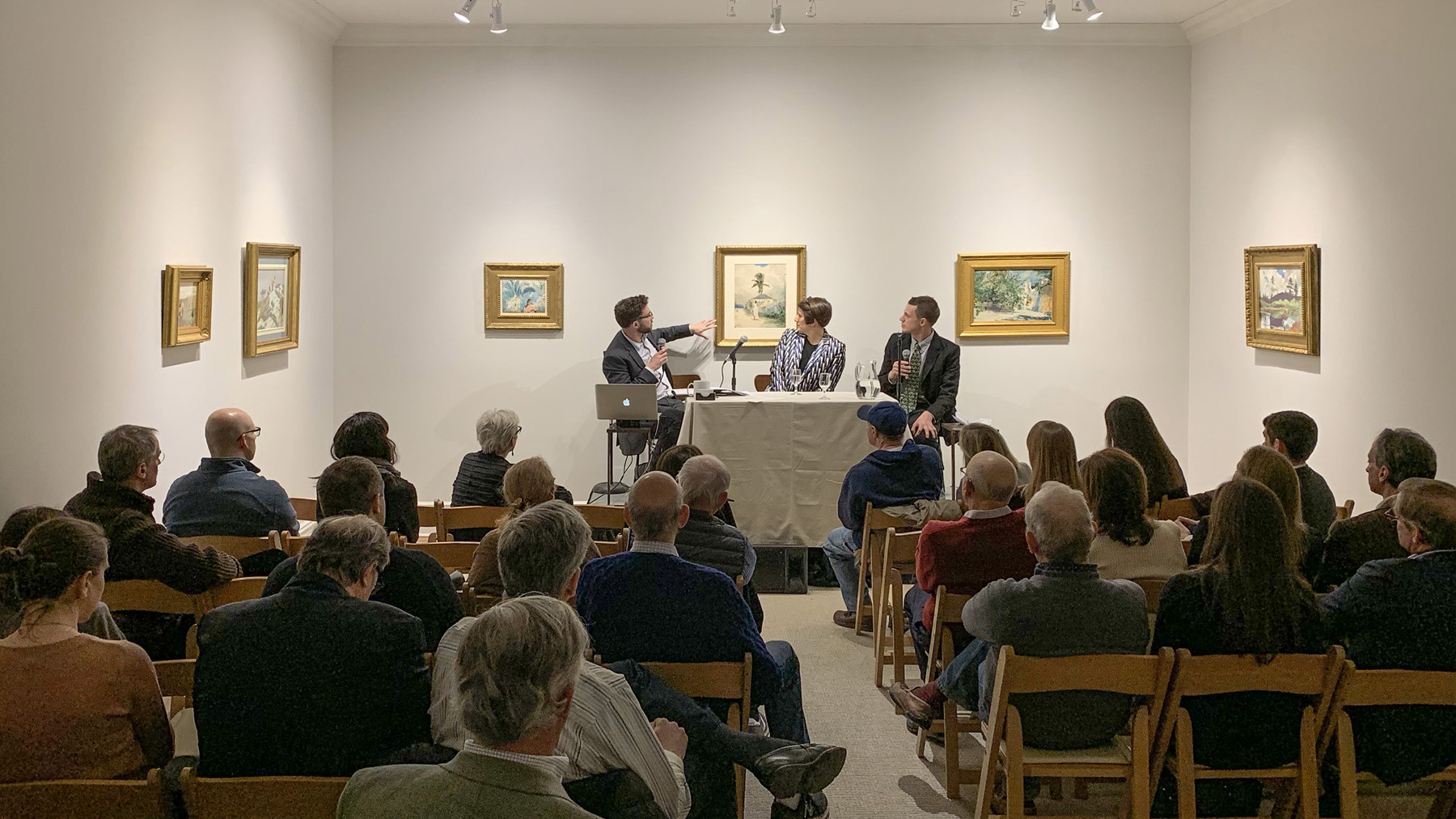
On Tueday, March 12, 2019, Menconi + Schoelkopf hosted our first in a series of talks that we’re calling “Pop-Up Symposia.” Volume I featured the Metropolitan Museum of Art’s Stephanie Herdrich and the Hudson River Museum’s Theodore Barrow in a conversation about Homer in the Tropics, with digressions on who was better, Sargent or Homer; how to make an alligator reveal its vulnerability; and the Boer War. A few excerpts from a great conversation, moderated by Jonathan Spies:

Jonathan Spies [00:00:22] Hassam and Sargent and other people in Boston who are definitely you know impressionists but also have more or less contemporaries of Homer doing similar things but just looking at some of these pictures these are so far from Haas and these are so far from Sargent Homer goes to Europe and ostensibly could have been exposed to a lot of things that Sargent and Hassam and other folks were exposed to. He seems to have learned nothing about like impressionism or at least doesn’t hold onto anything as far as I can tell. Homer from another planet. What is he doing?

Stephanie Herdrich [00:01:09] Well I do think as we sort of in our emails talked about you know there’s a generation difference between them. Yeah. So Homer is born in eighteen thirty six and Hassam is born in 1859 and I do think that’s a crucial difference that generation. Those you know Homer I think is so lucky they have a lot in common they’re in Boston they’re essentially self-taught they’re cobbling together the different kind of resources in Boston to create and form their own artistic education. They have parents who encouraged their interest in art. But Homer I think is so shaped by the Civil War and Hassam is born in 59 and he’s still a child and has really different opportunities. I think we all know that Homer begin and has and they both begin their career as illustrators. Homer becomes a painter during the Civil War and he actually travels to the frontlines in Virginia and is embedded with troops. And you know there’s we don’t know so specifically specifically about everything that he saw but we know when he returns his mother says that he was so changed. Even his closest friends didn’t recognize him. And I think that you know if I’m speculating. I mean I think that Homer. I would guess that he had a form of PTSD from what he saw during the war. I mean all Americans who lived through the Civil War which was obviously the most bloody and terrible war have to reckon with that in the years afterwards and having seen people die in battlefields. That’s something that’s deeply embedded in Homer’s psyche. So when he travels to Europe. Ahead of the Impressionists he’s looking at a much more kind of traditional education he’s looking at barbers on painters and you know Hassam does some of that too. But Hassam is in in Europe in 1883 and then again in 1887. So he really has more contact with the Impressionists. He travel he’s there much longer. He travels spends a lot of time in the French countryside. And I don’t. Think he feels the burden of the civil war in the same way that Homer does.

Jonathan Spies [00:03:33] I mean it’s interesting because Homer I mean as you say everybody of a generation who was around the civil war must have been deeply impacted by it. But there’s almost nobody else who almost nobody else who really reacts on canvas to to the civil war. And you know there’s sort of allegorical readings that you can find in Martin Johnson Heade and other landscapes and like that. But. But you know prisoners from the front veteran and you know feel these are really direct. Reactions to the civil war that you just don’t get from virtually anybody else. And so then you see you know the rest of his career you can sort of look at as a as a reaction or like mediation on that. And so just some of these pictures that we have almost this this little watercolor over and the right is called boys on a hillside and it’s got just two youngsters you know lay out frolicking in nature but there’s also I don’t know there’s something like he’s his preference for you know looking for lost innocence or something like that. It seems to be a major theme throughout his career.

Stephanie Herdrich [00:04:50] There’s just there’s always this stamp of the Civil War on on Homer and I think you see these echoes across his work as we’re saying. Like the painting like that picks up on themes that are in veteran and a new field the sadness the loss of the Civil War the devastated landscape the boy seen from behind kind of representing a more universal sentiment. And you know Homer as we all know kind of reiterates and explorers and re explores themes over and over in his career right.

Jonathan Spies [00:05:46] How broadly to look at the pictures in the tropics? As are they sporting pictures? Are they genre scenes? Are they anthropology, or you know what’s the—how to fit Homer in that moment, in the Bahamas and in Cuba. They’re just really strange pictures. I mean this right behind us is a fantastic example but it’s kind of an interesting outlier both in his work and in American art.

Stephanie Herdrich [00:06:27] Well I think that there’s a lot of impact in that question. One of the things that interests me is and it’s something that I did for many years to which is we kind of lumped the tropics together. And I think if we dissect the different trips and look at his Bahama works versus his Cuba works versus his Bermuda works we see that they are distinctive also. He’s his work. I think it’s transformed by the tropical light. So there’s a great advance in his watercolor technique but that there are kind of specific subjects that he explores in each of the different places and in the Bahamas. He’s really I think beginning to look at the lives of the local people and he’s thinking of a post slavery economy and the lives of these formerly enslaved people of African heritage. And what happens after slavery. This is something that interests him in the United States of course when he returns to the reconstruction south and paints a series of pictures. So that’s a theme that interests him. But I also see it kind of connected to like the color codes works in a sense which are painted in the years right before the Bahamas where he’s looking at the lives of these women and their daily life. So there’s a kind of continuum but also a kind of new exploration of themes. And then you know Cuba for example he’s so interested in the colonial the Spanish colonial past and he looks at the architecture and you can see from the watercolor here of the woman with the fan he’s really it’s the Spanish costume. That’s very prominent there and Ted we were talking about the sort of architectural interests in Cuba.


Ted Barrow [00:08:11] Well I think I agree with everything that Stephanie said about Homer’s continuation of certain themes and motifs. I also think that it’s interesting when he first goes to the Bahamas. He’s traveling with his father. His mother had passed away in April of that year. They leave in December as the middle child. He’s alone. It’s his duty to take care of his father and his father was pretty flamboyant and profligate pretty wasteful and you know it’s like an exaggerated version of love as Homer spent more time with him. Homer’s worst quality is he would complain about him all the time. So he’s you know it’s no surprise that he doesn’t depict his father or the Royal Victoria Hotel which was the biggest hotel in Nassau where they where they stayed. Instead he takes trips to Fox Hill which was the former slave neighborhood that was where the most of the Afro Caribbean bohemians lived and depicted oceanic dark skinned women children and sponges fishermen. And strangely enough I see a very interesting relationship between their work as laborers and an almost inverse reflection of Homer’s own identity. He never paints people that belong to his own class. He never paints himself, his father has. I mean he will paint portraits of his of his brothers or nieces nephews. But these are people that are shut out from walls. These are people that carry tropical fruit. These are people that work as that Labor on the sea. And I think that in painting the other you are finding a reflection of yourself in a way. So I mean it’s you know of the Afro Caribbean subjects of women walking along roads they are quite often cut off by a limestone wall from a lush tropical garden. They’re often carrying fruit. They’re often carrying chickens there. They’re at work in the same way carrying things that Homer also paints and is planning to sell.

Jonathan Spies [00:10:29] All right. We have oranges over here. This is you know something he’s focused on and even just the cropping of this picture over here is just you know there’s almost like a picture frame gives us a sort of wall separating us from the subjects as well as I had just found some quote from Sargent where he’s talking about. He’s just working in watercolor is making the best of an emergency. And I stumbled across something elsewhere. When he when Sargent was down in Florida he seems not to have come very prepared like he writes to a friend or somebody in the studio is like hey set me down some watercolor paper I should probably be painting while I’m here like he just hadn’t thought of it or something. And it just highlights quite a different a different attitude towards art making that the two had. But Sargent is down in Florida and there’s some stuff in the tropics. You’ve both done a lot of thinking about Sargent as well. My sort of outsider perspective is that Sargent is definitely an impressionist when he’s working in watercolor but in oil sometimes not so much like he sometimes has a much more static view that makes me think a little bit more of Homer more consistently. What what to make of this whereas the how do how does Homer relate to Sargent. I don’t know if there’s a if there’s something about the tropics that impacts both of them.

Stephanie Herdrich [00:11:59] Well I think to say first that Sargent goes to Florida for 1917 because he has a portrait commission. And by 1917 he is not interested in painting portraits anymore. So this is a burden to him. He is sort of like God I can’t believe he. It was a fundraiser for the Red Cross and he goes down there to paint John Rockefeller’s portrait and he is not happy about it. And he does kind of complain and he says there’s nothing to pay. But then once he starts painting I think he’s pretty prolific and excited about it. But I do think about Sargent as a watercolor painter is that he’s the master of making it look easy but he’s put a lot of effort into it and I’m going to give a shout out to the Met’s paper conservator Marjorie Shelley who with whom I worked with for so many years and who has taught me so much about looking at watercolors. But we did a catalogue years ago of the Met’s Sargent watercolors and she did great examinations of the watercolors using infrared reflector graffiti to look at the under drawings and what we found is that many of them had these completely thorough under drawing. So very premeditated measured he’s using rulers or a compass. So in some instances but then his brilliance is that he comes in and he makes it look like he dashed it off in 10 seconds. And obviously there is an expediency of watercolor right. That fluidity and you can’t make mistakes but he’s kind of fooling us into thinking he’s an impressionist whereas do you want to talk about Homer’s watercolor.

Ted Barrow [00:13:40] Yeah I would consider Homer much more of a realist in that if we’re going use that. I mean he was accused of being an impressionist by American critics but their understanding of Impressionism in the 1870s and 1880s was different than how we think of “impressionist”. It was an insult. I would think that with Homer he’s scraping away figures and there is a bit of spontaneity but it always seems much more pent up in tightly composed in the way, like comparing Corbet or Millet to Manet or Monet. I know I’m mixing impressionists and realists but you know it’s a similar relationship but again in the tropics and in Florida particularly about six and a half years after Homer’s death I think that Sargent is in a mode where he’s thinking of himself as being an American artist and he is painting these watercolors with Homer in mind so in and I don’t think the artists are aware of one another in their lifetimes when their lives overlap. I’ve done a little bit of research; this is my conspiracy theory. Might as well just share it with everyone. Sargent’s first. The first painting that Sargent shows in the States at the Society of American artists in 1878. A sketch of the oysters gatherers that—I can’t recall the name of the critic, but describes Sargent as “exquisite nothing short of exquisite.” And then Homer. Across town at the National Academy is showing his two guides. That very same critic who talks about how an exquisite Homer’s two guides uses that word. And so I think probably that stuck in Homer’s craw. Starts to move more into working more actively with dealers doing scenes in color coats which I think in some ways resemble what Sargent had shown in the States at this at the Society for American artists so. So I think that there is an interesting relation push and pull there between these two artists. And I don’t know if Homer is thinking of Sargent in the tropics but I would guess I would bet that Sargent is aware of Homer while he is in Florida. Do you have a pet conspiracy theory.

Stephanie Herdrich [00:16:33] Yeah I think I mean it’s you know they’re set up very early on by the critics as the kind of the in their lifestyle. Sargent is the cosmopolitan European trained and Homer is the American. And Henry James is another one who writes about both of them early on. And of course James is just enchanted with Sargent and he likes Homer too. But he talks about his ugly milkmaid. And you know the plainness of his subjects. So they’re set up very early on by the critics to have this kind of dichotomy which are at extremes which I mean the reputations that lasts until today I think you Sargent is the cosmopolitan Homer’s The American and in the subjects they painted and the people they represent. I mean Sargent when he goes down to Florida he finds he works at Palm trees which Homer obviously like he also does those alligator paintings which are so I mean there’s this exotic quality to them which is pretty over the top. I feel like Homer have painted those pictures. I don’t know if that’s right.

Ted Barrow [00:17:38] I don’t think he would have painted them in that way. But he met Homer does painting scenes and in the swamps involving reptiles and an exotic fauna.

I think I think Sargent is well—first of all, Henry James goes to Florida to you know it’s just like that. What’s interesting about this my topic I think is everyone goes down there and they all think about it. And before Homer Goes there you have Martin Johnson he’d you have in his wintering in Florida Thomas Moran goes to Florida and they painted in this picturesque and sometimes romantic mode identical pastoral. Both Homer and Sargent don’t look away from modernity you know their bottles floating and in the water and channel bars their Sargent is painting development in the background and his portrait of Charles Deering. And so I think that on that realist approach to painting Florida is something that links them and not many American artists at that time are doing something else but I don’t want to ask you Stephanie about this sort of the the gender or sexual politics of Homer and Ted touched on this a little bit but you have this these sort of I guess there’s racial politics as well.

Jonathan Spies [00:23:13] I just had a few more questions but one of these was just who do you like better Sargent or Homer.

Stephanie Herdrich [00:23:22] It’s like you know when your children say ‘She’s your favorite!’

Ted Barrow [00:23:28] I think since we’re spending time with Winslow homers I’m going to side with Homer but if there were just as many, an equal amount of Sargents I would I mean it’s for very different reasons it’s oranges and palm trees. It depends on what you want to look at. Do you want to look at Delacroix or Ingres. You can . . .You can enjoy both.

Ted Barrow [00:25:20] What draws me to Homer is there’s always this diagonal pull in and out of each of his images are you can almost feel the pull of the canoe as it as the like visually dire. Yeah right. But also just in terms of like force often I find as much as I love Sargent’s watercolors and is as oil paintings. He brings everything to the surface. You know he’s really interested in camouflaging in a way that that I don’t find happening. Interestingly enough he works with there on you know sort of these ideas of camouflage at the beginning of World War One and just you know Sargents use of lead based white paint which of course was necessary at the time. That was how white paint came out it really gives a materiality to parts of the surface of his canvases that maybe shouldn’t. I was just at the Met I think I still have my sticker somewhere looking at the Hermitage it’s all the trio and just the way in which that body materializes into the background something Homer would never do. It’s a different kind of interplay between like the surface painting the plane of the picture and the space suggested within I don’t know if it’s choosing sides.

Jonathan Spies [00:26:45] No we don’t have to fight that battle anymore. Just getting back to the Alligator pictures. Your remarks about camouflage and surface. Really bring that to mind because that’s something else that we’ve talked about in the past is that you have these menacing creatures you know that Sargent is just lavishing all this tactical proficiency on and seeing them in person it’s like all these little. It’s like everything you could do with a watercolor you know using reserve using gum Arabic to pull back to white and that’s scratching into everything you could do with a watercolor is in those pictures. And there’s something that’s just not very actually frightening about them because they’re so luscious. Yeah. You just want to sort of enjoy this. The surface quality to them which is which is interesting and I feel like there’s not even just little things like this. I’m not sure what the narrative is here. There’s some sense of maybe that menace but there’s a there’s a sense of investment and maybe not danger but something risk in this picture.

Ted Barrow [00:27:56] So yeah I think one of the things when he first starts painting homemade imagery and palm trees Homer often is like painting tropical storms and just the sway of that palm tree and the direction that the that the fronds are blowing and you get this sense of you see steamships on the horizon you see all the older ships in the water the sense of both kind of solitude in that figure but also this very fragile world that just someone coming from the Northeast must have looked very quickly built in very vulnerable. I mean you know taking ward lines steamship down in four days from New York’s harbor and ending up in NASA seems like a very some culture shock happening there.

Jonathan Spies [00:28:46] And indeed there were there was some vulnerability right. So I’m sure. And I don’t know what you’ve what you’re drawing into your show but he does all these pictures of you know like after the hurricane. And you know that just the devastation of course the vulnerability to nature that sort of thing.

Stephanie Herdrich [00:29:07] I think in these watercolours in particular of the tropics for Homer there is a there is a tension between that kind of beauty of them and the setting and often the sunlight. But then there’s a menacing quality to nature and there’s always a kind of disquieting sense that you know this storm is coming or it’s passed through the trees or blowing their scenes of shipwrecks. There’s sharks circling derelict vessels. You know that if we they can be very sunny and bright but there is still this kind of dark moodiness in them that and a kind of atmosphere not just a weather atmosphere but that kind of a somber mood that can permeate them.

Stephanie Herdrich [00:30:03] Homer returns to the region again and again. So I do think it sort of infiltrates him and I think that he has a sense of. Obviously he respects the sea and the power of the sea. But he’s thinking about the Gulf Stream. The tropical current and I think he develops this really kind of sense of the ocean and I kind of think the current of the Gulf Stream as a link between all of these places that he paints so he’s very connected. He see you know he’s painting in the Florida Keys where you know sort of where the Gulf Stream begins and the region wraps around the Bahamas and Cuba up the coast all the way towards Maine and then across the ocean to England. I mean these are all the places that he paints and that he loves to paint. And I think that he’s making this connection to the ocean to the current and the power of it. And that’s a way that all of these things end up connecting in his work so that you know the vessels the sailing boats in the Bahamas are have connections to the lives of the north New England fishermen working.

Theodore Barrow He paints portraits of his brothers. He paints caricature. He draws caricatures of his father really humorous ones and he paints the portrait of Helena decay which was one of these possible objects of love interest or longing for Homer in the early 1970s. Interestingly enough one of the watercolor sketches he does of her pregnancy does she is carrying a fan. And so I’m very interested in what drew him to fans besides their wonderful compositional potential. And in the Spanish girl with the fan. But in most cases I think many of his models are identifiable if they’re but they don’t really serve as strict but like portraits in the sense that Sargent would paint portraits.

Stephanie Herdrich [00:32:00] And I’m also thinking of when we talk about the Civil War works for example a work like veteran in a new field where you don’t see the face and this figure is seen as kind of every man every veteran on the other hand you have a painting at the Met like prisoners from the front where which it shows. I don’t know what his office was Francis Channing Barlow is he General General shows him with a group of prisoners and it’s a very specific portrait. So Homer is kind of genius at sort of blending the kind of specific details making them more universal. So painting like prisoners from the front has very specific portraits of individuals but it’s sort of or character or car right. Well I would argue that in a way it it it transcends the specific portraits to become a painting that encapsulates the whole conflict of the war between north and south and the different kinds of soldiers. So there’s again this kind of wonderful tension in his work between in this case the sort of specific identifiable and the broader theme.

Jonathan Spies [00:40:14] Just to wrap up are there any upcoming shows not at your respective institutions that you’re not working on that or other interesting things that you want to play that you’re excited about personally. It could just be like Game of Thrones.


Ted Barrow [00:40:29] I’m very excited about Game of Thrones but I’m also here. Since I’m not working at the Met I’m very excited about Stephanie’s upcoming Homer in the tropics show of course.

Jonathan Spies [00:40:43] And when does that actually when should we expect that 2020 to spring –

[Microphone falls to the floor with a loud bang]

Stephanie Herdrich [00:40:59] Mike drop!

Jonathan Spies [00:40:52] That’s not what that means. Spring 2022 that’s what we have to look forward to mark your calendars.

Stephanie Herdrich [00:40:59] There’s a bunch of good things coming up and there actually is going to be a small but looks interesting show at the Cape Anne Historical Society this summer about Homer and the sea and they’ve gotten some really good loans. I’m going to be I think a nice group of watercolors and oil sketches so if you’re up at the beach and then this fall there is going to be a surge a show of Sargent’s charcoal portraits at the Morgan Library. American Pre-Rafaelite show at the National Gallery in Washington opens in a few weeks.

Jonathan Spies [00:41:34] Awesome. Thanks so much guys. It’s been really fun talking to you.

angles